
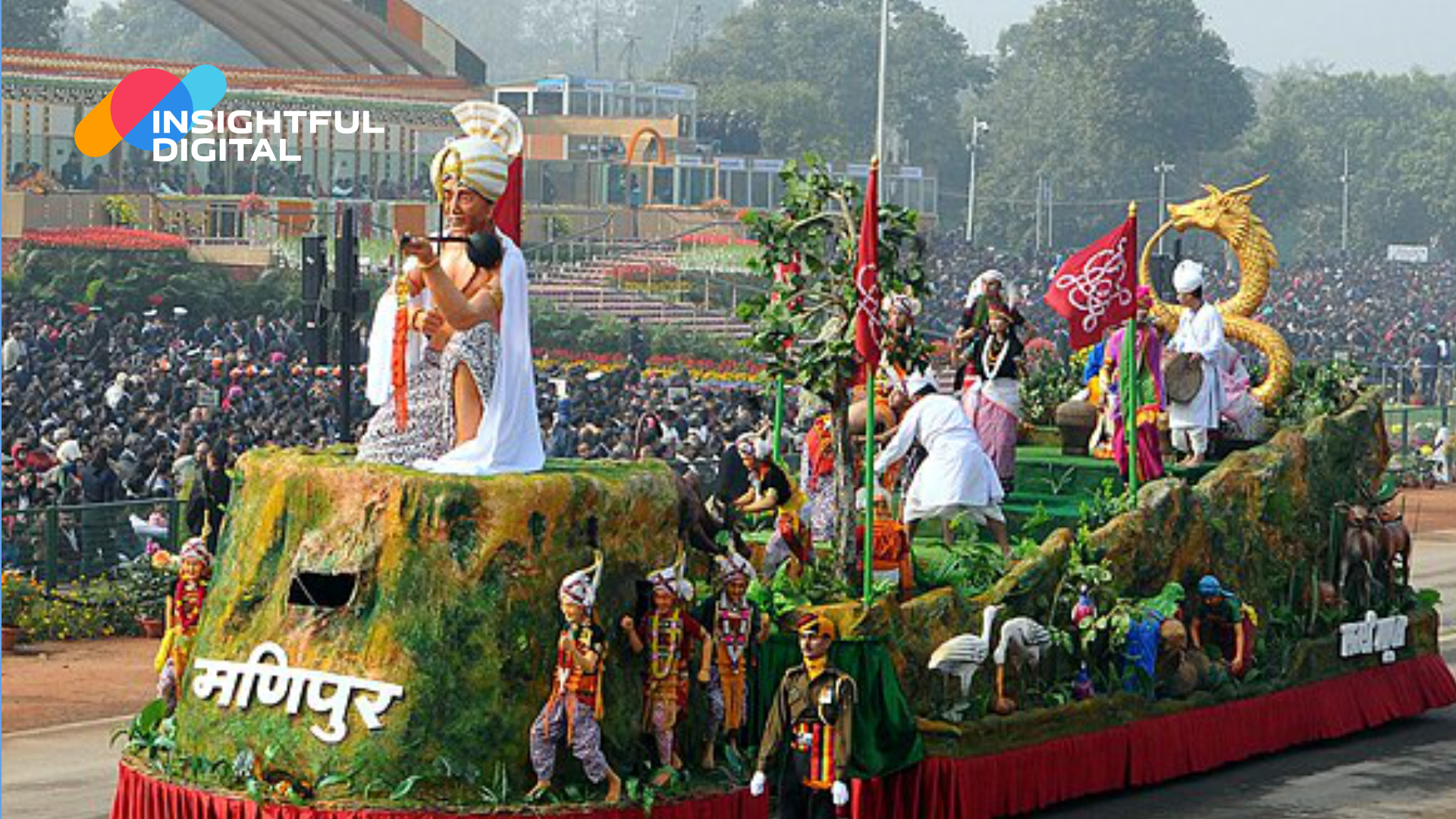
Manipur, located in Northeast India, is a land of lush green valleys, surrounding hills, and vibrant traditions. It shares international borders with Myanmar, making it strategically significant for trade and security. The capital city, Imphal, is the cultural and administrative center. Manipur became a full-fledged state of India on 21st January 1972.
Historical Significance
- Manipur has a recorded history of over 2,000 years, with references in ancient texts like the Mahabharata.
- The kingdom of Manipur was ruled by the Meitei kings, most notably King Pamheiba (Garibniwaz) in the 18th century.
- In 1891, Manipur fought the Anglo-Manipuri War against British colonial forces.
- After independence, Manipur merged with the Indian Union in 1949.
- Classical dance Ras Lila, introduced by King Bhagyachandra in the 18th century, symbolizes its cultural richness.
Geography & Location
- Area: ~22,327 sq. km.
- Borders: Nagaland (north), Assam (west), Mizoram (south), Myanmar (east & southeast).
- Physiography: Surrounded by hill ranges; Central Imphal Valley is the most fertile region.
- Rivers: Barak, Imphal, Thoubal, Iril, Chakpi.
- Climate: Subtropical; moderate rainfall, pleasant winters.
- Important Cities: Imphal, Churachandpur, Thoubal, Ukhrul, Bishnupur.
- Districts (16): Bishnupur, Chandel, Churachandpur, Imphal East, Imphal West, Jiribam, Kakching, Kamjong, Kangpokpi, Noney, Pherzawl, Senapati, Tamenglong, Tengnoupal, Thoubal, Ukhrul.
Culture & Traditions
- Dance: Ras Lila (classical dance), Lai Haraoba, Thabal Chongba.
- Festivals: Yaoshang (like Holi), Ningol Chakouba, Lai Haraoba, Kang Festival.
- Sports: Polo (believed to have originated in Manipur as “Sagol Kangjei”), football, boxing, weightlifting.
- Cuisine: Eromba, Chamthong, Singju, Chakhao (black rice pudding).
- Handicrafts & Handloom: Manipuri shawls, bamboo crafts, black pottery of Longpi village.
Language & Literature
- Official Language: Meitei (Manipuri).
- Other Languages: Tangkhul, Thadou, Mao, Rongmei, Hindi, English.
- Literature: Ancient text “Cheitharol Kumbaba” (royal chronicle).
Demographics & Society
- Population: ~30 lakh (2011 Census: 28.6 lakh).
- Ethnic Groups: Meiteis (valley), Nagas and Kukis (hills), Pangals (Manipuri Muslims).
- Religions: Hinduism, Christianity, Islam, Sanamahism (traditional faith).
- Literacy Rate: ~76.9%.
Economy & Development
- Agriculture: Rice, maize, pulses, potato, horticulture crops.
- Industries: Handloom & handicrafts, bamboo products, tourism.
- Natural Resources: Forests, medicinal plants, hydroelectric potential.
- Tourism: Loktak Lake (with floating Phumdis), Keibul Lamjao National Park (home to Sangai deer), Kangla Fort, Ima Keithel (all-women market).
Education & Institutions
- Manipur University, Central Agricultural University, National Institute of Technology (NIT), Regional Institute of Medical Sciences (RIMS).
Conclusion
Manipur, the “Jewel of India,” represents a blend of natural beauty, martial traditions, and cultural depth. From polo and Ras Lila to Loktak Lake and the Ima Market, it embodies both tradition and resilience. Strategically important and culturally rich, Manipur holds a unique place in India’s northeastern region.
Objective Questions for Competitive Exams
Q1. When did Manipur become a full-fledged state of India?
a) 1949
b) 1956
c) 1972
d) 1987
Answer: c) 1972
Q2. What is the capital of Manipur?
a) Kohima
b) Aizawl
c) Imphal
d) Agartala
Answer: c) Imphal
Q3. Which dance form is Manipur famous for?
a) Kathakali
b) Bharatanatyam
c) Ras Lila
d) Kuchipudi
Answer: c) Ras Lila
Q4. Polo, believed to have originated in Manipur, is locally called:
a) Mallakhamb
b) Sagol Kangjei
c) Thang-Ta
d) Sepak Takraw
Answer: b) Sagol Kangjei
Q5. Loktak Lake is famous for:
a) Tea gardens
b) Floating islands (Phumdis)
c) Oil fields
d) Coral reefs
Answer: b) Floating islands (Phumdis)
Q6. Keibul Lamjao National Park is unique because it is:
a) Desert National Park
b) Only floating national park in the world
c) Oldest national park in India
d) Largest mangrove park
Answer: b) Only floating national park in the world
Q7. The Sangai deer, found only in Manipur, is also known as:
a) Dancing deer
b) Flying deer
c) Running deer
d) Water deer
Answer: a) Dancing deer
Q8. Which market in Imphal is run entirely by women?
a) Sarojini Market
b) Ima Keithel
c) Apna Bazaar
d) Kangla Market
Answer: b) Ima Keithel
Q9. Which country shares an international border with Manipur?
a) Nepal
b) Bhutan
c) Myanmar
d) Bangladesh
Answer: c) Myanmar
Q10. The ancient chronicle “Cheitharol Kumbaba” belongs to:
a) Assam
b) Manipur
c) Nagaland
d) Tripura
Answer: b) Manipur