
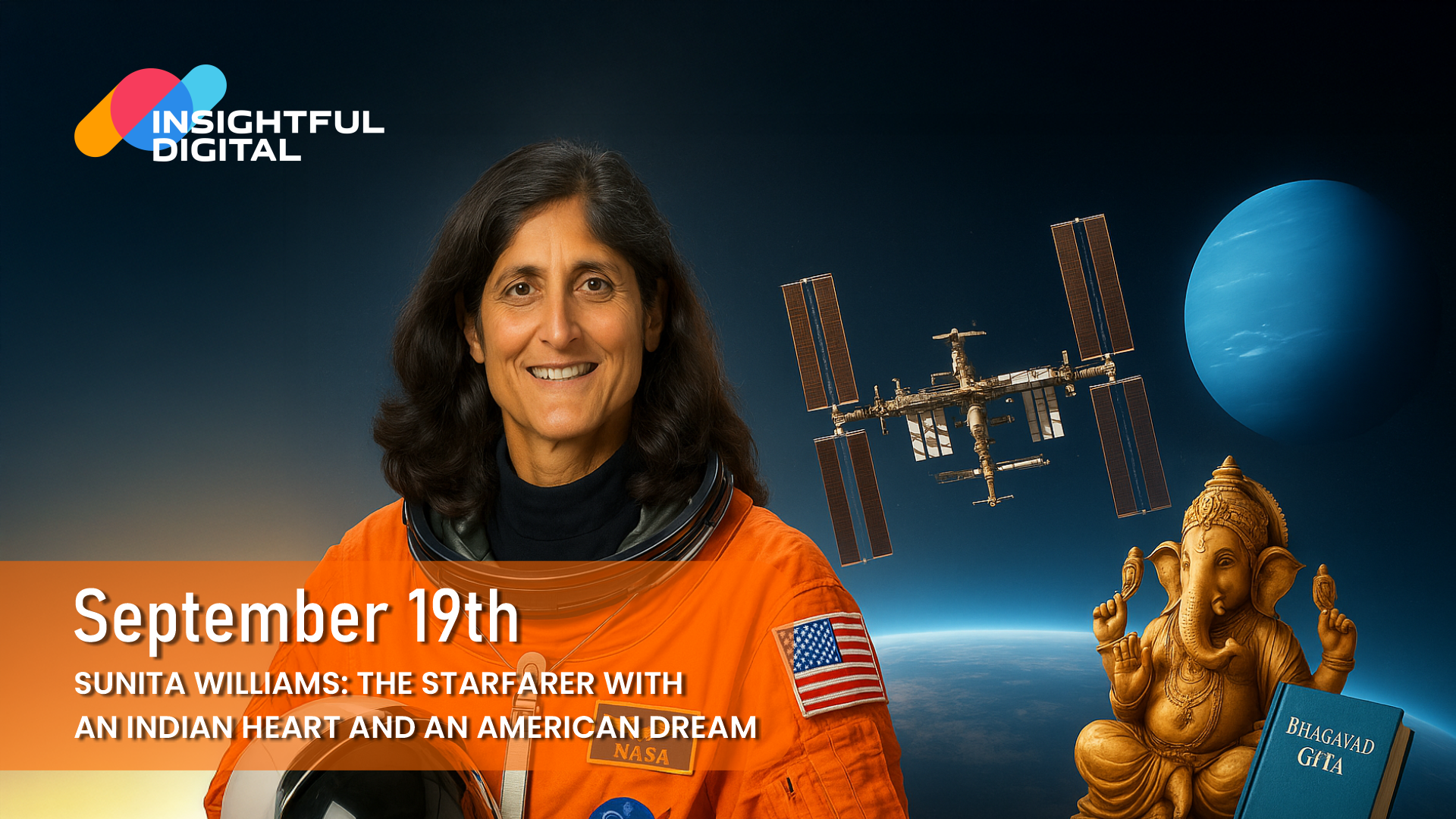
Sunita “Suni” Williams is a name that resonates across the globe, not just as a record-breaking NASA astronaut, but as a powerful symbol of multicultural identity, perseverance, and human achievement. Her journey from a curious child to a veteran of space exploration is a modern epic, blending her Indian heritage with her American upbringing into a story that inspires millions.
Early Life and the Call of the Sea (and Sky)
Born on September 19, 1965, in Euclid, Ohio, to Deepak Pandya and Bonnie Pandya, Sunita’s life was infused with a rich cultural tapestry from the beginning. Her father, a renowned neuroanatomist from Gujarat, India, and her mother, a Slovenian-American from Ohio, provided a diverse and intellectually stimulating environment.
While she had no direct familial connection to aviation or space, the spark of adventure was ignited early. A trip to Florida to watch the return of the Apollo capsule left a young Sunita in awe. However, her first love was not the sky, but the sea. Inspired by her elder brother Jay, she set her sights on becoming a veterinarian and then a Navy diver. She eventually attended the U.S. Naval Academy, graduating with a degree in Physical Science in 1987. She was commissioned as an Ensign in the U.S. Navy and began training to become a helicopter pilot, later transitioning to test pilot school—a common pathway for many astronauts.
From Naval Aviator to NASA Astronaut
Williams’s career as a naval aviator was distinguished. She logged over 3,000 flight hours in more than 30 different aircraft. It was this exceptional record as a test pilot, combined with her sharp intellect and physical prowess, that caught NASA’s attention. In June 1998, she was selected as a NASA astronaut candidate, officially beginning her journey to the stars.
Her training was rigorous, encompassing everything from geology and robotics to survival skills and intensive Russian language courses to prepare for collaboration on the International Space Station (ISS).
Record-Breaking Missions to the International Space Station
Expedition 14/15 (Dec. 2006 – June 2007):
Williams first launched into space aboard the Space Shuttle Discovery on mission STS-116 on December 9, 2006. She joined the Expedition 14 crew on the ISS as a flight engineer. During this six-month stint, she etched her name into the history books:
- Most Spacewalks by a Woman: She conducted four spacewalks, totaling 29 hours and 17 minutes outside the station.
- Longest Single Spaceflight by a Woman: She spent 195 days in space, a record at the time.
- Most Total Spacewalk Time for a Woman: Another record she set during this mission.
Beyond the records, she captured the world’s imagination by running the first marathon in space. While astronauts on Earth ran the Boston Marathon, Williams ran the same 26.2-mile distance on the station’s treadmill, tethered to it with bungee cords.
Expedition 32/33 (July – November 2012):
Williams returned to the ISS in July 2012, this time as part of a Russian Soyuz crew. She took command of the station in September, becoming only the second woman to hold that prestigious position. During this 127-day mission, she added two more spacewalks to her tally, bringing her total to seven. With over 50 hours of cumulative EVA (Extravehicular Activity) time, she further cemented her status as one of the most experienced spacewalkers in history.
A Deep Connection to India
Sunita Williams has never shied away from celebrating her Indian roots. During her first mission, she carried with her:
- A copy of the Bhagavad Gita.
- A small statue of Lord Ganesha.
- Samosas from her father, which she shared with her crewmates.
She has spoken fondly of her visits to India, including a trip to her father’s ancestral home in Gujarat, where she connected with her extended family. She often addresses Indian audiences with a warm "Namaste," making her a beloved figure in the country. Indians see in her a reflection of their own potential on the world stage, a diasporic success story that feels both foreign and intimately familiar.
The Next Frontier: Boeing Starliner
Even after her illustrious ISS missions, Williams’s career continues to be groundbreaking. She was selected as one of the first astronauts to fly on Boeing’s CST-100 Starliner spacecraft, part of NASA’s Commercial Crew Program. Alongside astronaut Barry "Butch" Wilmore, she was set to pilot the first crewed test flight of this new vehicle.
This mission represents a new chapter in American spaceflight, moving from government-operated shuttles to commercial providers. While the mission has faced technical delays, Williams’s role in it highlights NASA’s continued trust in her skills and composure as a pioneer on the cutting edge of space travel.
Legacy and Inspiration
Sunita Williams’s legacy is multifaceted:
- A Trailblazer for Women in STEM: She has demonstrably broken barriers for women in aerospace, showing that they can not only participate but excel and lead in the most demanding environments imaginable.
- A Cultural Icon: She embodies the beautiful synergy of a multicultural identity, proving that one can honor multiple heritages and inspire people across continents.
- A Symbol of Perseverance: Her path—from aspiring diver to record-holding astronaut—showcases the power of adaptability, lifelong learning, and relentless determination.
- The Human Face of Space Exploration: Through her infectious enthusiasm, running marathons in zero-g, and sharing samosas in space, she has made the incredible journey of spaceflight relatable and deeply human.
Sunita Williams is more than an astronaut; she is a explorer in the truest sense, continually pushing the boundaries of what is possible, both for herself and for all of humanity. As we look to the future of spaceflight—to the Moon, Mars, and beyond—her story remains a guiding star, reminding us that with courage and curiosity, the sky is not the limit; it's just the beginning.
Objective Questions (MCQs)
Q1. When was Sunita Williams born?
a) July 20, 1969
b) September 19, 1965
c) December 9, 2006
d) June 1998
Answer: b) September 19, 1965
Q2. Where was Sunita Williams born?
a) Ahmedabad, India
b) Imphal, India
c) Euclid, Ohio, USA
d) Houston, Texas, USA
Answer: c) Euclid, Ohio, USA
Q3. From which academy did she graduate in 1987?
a) U.S. Air Force Academy
b) U.S. Naval Academy
c) MIT
d) Caltech
Answer: b) U.S. Naval Academy
Q4. In which year was she selected as a NASA astronaut candidate?
a) 1995
b) 1998
c) 2001
d) 2006
Answer: b) 1998
Q5. Sunita Williams first went to space on which mission?
a) STS-135
b) STS-116 (Space Shuttle Discovery)
c) Expedition 1
d) Apollo 13
Answer: b) STS-116 (Space Shuttle Discovery)
Q6. How many spacewalks did she perform during Expedition 14/15?
a) Two
b) Three
c) Four
d) Seven
Answer: c) Four
Q7. What was the duration of her longest single spaceflight on the ISS?
a) 127 days
b) 50 hours
c) 195 days
d) 29 hours 17 minutes
Answer: c) 195 days
Q8. What unique athletic feat did Sunita Williams accomplish in space?
a) First space triathlon
b) First marathon run in space
c) First spacewalk without tether
d) First zero-g yoga session
Answer: b) First marathon run in space
Q9. During Expedition 32/33, Sunita Williams became:
a) The first woman on the Moon
b) The first woman to command the ISS
c) The second woman to command the ISS
d) The first Indian citizen in space
Answer: c) The second woman to command the ISS
Q10. Which items did she carry to honor her Indian roots?
a) A sitar and a sari
b) Bhagavad Gita, Ganesha idol, and samosas
c) A tricolor flag and diya
d) Yoga mat and spices
Answer: b) Bhagavad Gita, Ganesha idol, and samosas
Q11. With whom was she slated to fly the Boeing Starliner’s first crewed test flight?
a) Sunita’s brother Jay
b) Peggy Whitson
c) Barry “Butch” Wilmore
d) Yuri Gagarin
Answer: c) Barry “Butch” Wilmore
Q12. Her cumulative spacewalking (EVA) time exceeded:
a) 10 hours
b) 25 hours
c) 50 hours
d) 100 hours
Answer: c) 50 hours