
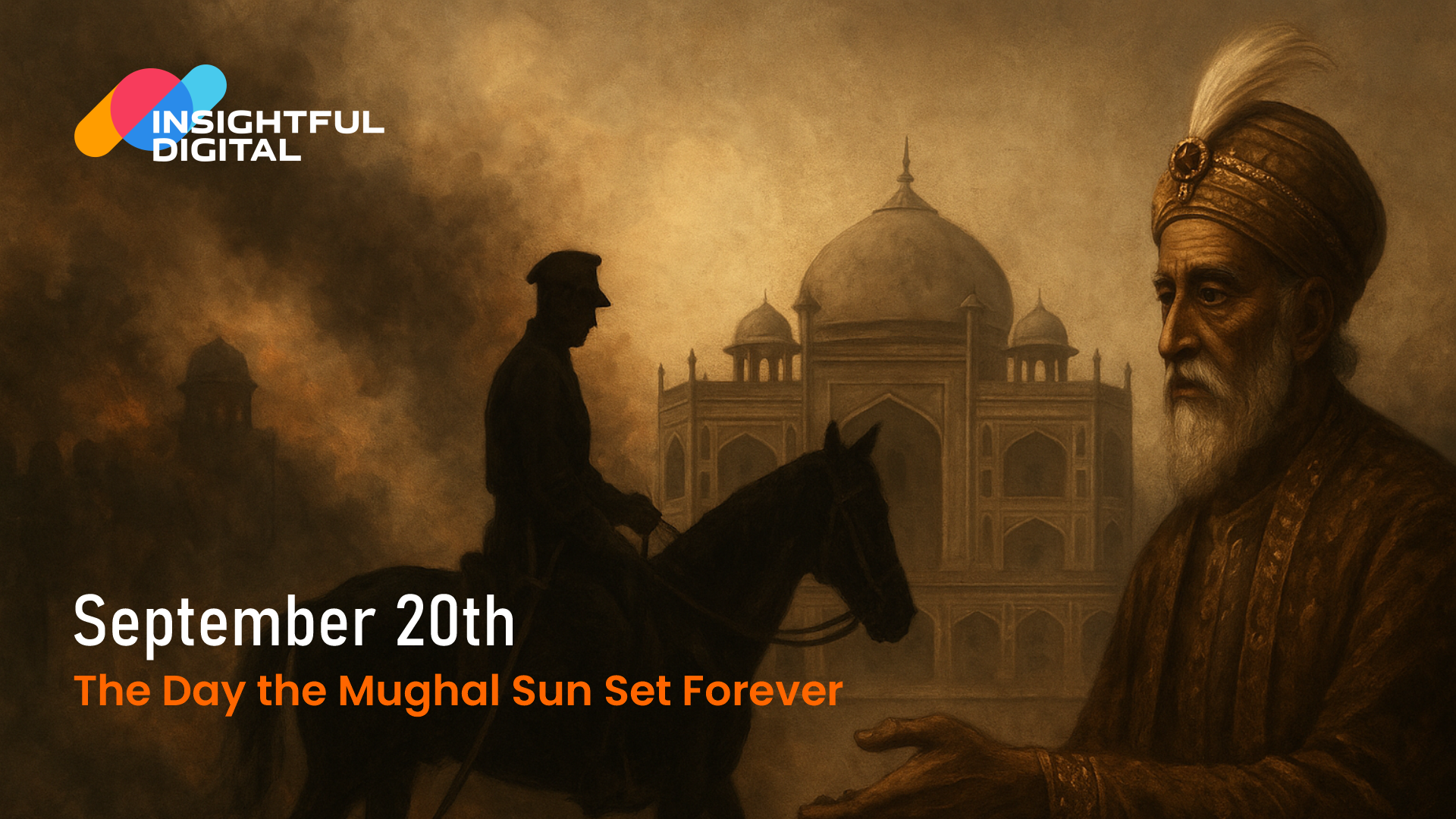
In the grand, sweeping narrative of history, certain dates mark not just an event, but the definitive end of an era. September 20th, 1857, is one such date for India. On this day, the last Mughal Emperor, Bahadur Shah Zafar II, surrendered to the British forces led by Major William Hodson. This was not merely the capture of a king; it was the symbolic and brutal termination of a dynasty that had ruled parts of the Indian subcontinent for over three centuries, and the final, crushing blow to the First War of Indian Independence.
The Prelude: The Revolt and the Reluctant Emperor
By 1857, the Mughal Empire existed in name only. Its authority had shrunk to the walls of the Red Fort in Delhi, and the 82-year-old Bahadur Shah Zafar was a pensioner of the British East India Company, more devoted to poetry and Sufism than to power or politics.
The Sepoy Mutiny of May 1857 changed everything. The rebellious Indian sepoys from Meerut, having turned on their British officers, surged into Delhi and demanded that the aging emperor lead them. They needed a symbol, a figurehead to legitimize their uprising and unite the diverse factions rebelling across North India. Zafar, a gentle soul caught in a tempest not of his making, was reluctantly proclaimed the Emperor of Hindustan.
For four tense months, Delhi became the epicenter of the revolt. The city was under the nominal control of the sepoys and the emperor, but the administration was chaotic, lacking a clear military strategy or unified command. The British, after initial shock, regrouped and began their bloody reconquest of the city in June.
The Fall of Delhi and the Hunt for the Emperor
After weeks of fierce street-by-street fighting, the British forces, under the command of General Archdale Wilson, finally recaptured Delhi on September 14, 1857. The aftermath was a horrific orgy of vengeance. British soldiers went on a rampage, killing thousands of innocent citizens and sepoys alike in what can only be described as a massacre. The Mughal princes and the royal family, however, had taken refuge at the sacred dargah of Humayun’s Tomb, about 6 miles from the Red Fort.
Major William Hodson, an intelligence officer known for his ruthlessness and daring, was tasked with securing the emperor's surrender and capturing the princes. On September 20th, Hodson, with a small contingent of Sikh soldiers from the British force, rode out to Humayun’s Tomb. He was vastly outnumbered by the emperor's guards and supporters but relied on sheer audacity and the psychological advantage of the British victory.
The Surrender: A Treaty of Broken Promises
Confronting the emperor, Hodson presented his terms. He promised Bahadur Shah Zafar that his life would be spared if he surrendered unconditionally. Isolated, defeated, and broken, the elderly poet-king had little choice. He agreed to the terms and submitted to Hodson.
The most tragic and brutal chapter was yet to come. Hodson also demanded the surrender of the emperor's three sons and a grandson—Mirza Mughal, Mirza Khizr Sultan, and Mirza Abu Bakr—who were key figures in the revolt. They were the symbolic heirs to the Mughal throne and their existence was a threat to British power.
Hodson secured their surrender as well, promising them safe passage. However, on the ride back to Delhi, Hodson halted the procession at a deserted area near the Delhi Gate. Alleging that a crowd was gathering to attempt a rescue, he ordered the three princes to strip off their upper garments. In a cold-blooded act of treachery and realpolitik, he then took a carbine from one of his troopers and shot them dead at point-blank range. Their bodies were later displayed publicly at a kotwali (police station) to terrorize the population and extinguish any remaining hope of Mughal restoration.
The Aftermath: The End of an Epoch
The surrender of September 20th had immediate and profound consequences:
The Trial and Exile: Bahadur Shah Zafar was put on trial in the Red Fort for rebellion and complicity in the murder of Europeans. He was found guilty and exiled to Rangoon, Burma (now Myanmar), in October 1858. He lived his last years in captivity, lonely and heartbroken, penning poignant poetry about his fate. He died in 1862 and was buried in an unmarked grave. His famous couplet captures his despair:
"Kitna hai bad-naseeb Zafar, dafn ke liye
Do gaz zameen bhi na mili ku-e-yaar mein."
(How unfortunate is Zafar! For his burial
He couldn't get two yards of earth in the land of his beloved.)
Formal End of the Mughal Empire: The British used the rebellion as the pretext to formally abolish the Mughal Empire. The Government of India Act 1858 transferred power from the East India Company to the British Crown, beginning the period of direct British rule, known as the British Raj.
A Symbol of Resistance and Tragedy: Bahadur Shah Zafar's tragic end transformed him from a reluctant leader into a potent symbol of resistance against colonial rule. His surrender marked the end of medieval India and the beginning of a new, more intense phase of colonial subjugation.
Conclusion: The Echoes of History
September 20th, 1857, is therefore a day of profound historical reckoning. It marks the moment the last vestige of indigenous imperial rule was extinguished. The events of that day—the broken promise, the surrender of a king, and the murder of princes—encapsulate the brutality and calculated realpolitik of colonial conquest.
The surrender of Bahadur Shah Zafar is more than a historical footnote; it is a watershed moment that shaped the political and cultural trajectory of the Indian subcontinent. It serves as a somber reminder of the end of an ancient order and the painful birth pangs of a nation struggling to be free. The echo of that day would reverberate through the next 90 years of the freedom struggle, until India finally regained its sovereignty in 1947.
Objective Questions for Competitive Exams
Q.1. On which date did Bahadur Shah Zafar surrender to the British?
a) September 14, 1857
b) September 20, 1857
c) October 20, 1858
Answer: b) September 20, 1857
Q.2. Who led the British detachment that secured Bahadur Shah Zafar’s surrender?
a) General Archdale Wilson
b) Major William Hodson
c) Lord Canning
Answer: b) Major William Hodson
Q.3. Where did the Mughal royal family take refuge before the surrender?
a) Red Fort
b) Humayun’s Tomb
c) Jama Masjid
Answer: b) Humayun’s Tomb
Q.4. Which British commander recaptured Delhi on September 14, 1857?
a) General Archdale Wilson
b) Sir Colin Campbell
c) Lord Dalhousie
Answer: a) General Archdale Wilson
Q.5. Which princes were executed by Hodson after being promised safe passage?
a) Mirza Fath ul-Mulk & Mirza Firuz Shah
b) Mirza Mughal, Mirza Khizr Sultan, and Mirza Abu Bakr
c) Mirza Jahangir & Mirza Salim
Answer: b) Mirza Mughal, Mirza Khizr Sultan, and Mirza Abu Bakr
Q.6. Near which gate were the princes executed?
a) Kashmir Gate
b) Ajmeri Gate
c) Delhi Gate
Answer: c) Delhi Gate
Q.7. To which place was Bahadur Shah Zafar exiled after his trial?
a) Andaman Islands
b) Rangoon (Burma)
c) Mauritius
Answer: b) Rangoon (Burma)
Q.8. Which Act transferred power from the East India Company to the British Crown?
a) Government of India Act 1858
b) Indian Councils Act 1861
c) Charter Act 1833
Answer: a) Government of India Act 1858
Q.9. What age was Bahadur Shah Zafar around the time of the 1857 revolt?
a) About 60 years
b) About 72 years
c) About 82 years
Answer: c) About 82 years
Q.10. Where were the bodies of the executed princes publicly displayed to instill terror?
a) At the Red Fort
b) At a kotwali (police station)
c) At Chandni Chowk
Answer: b) At a kotwali (police station)
Q.11. Which line best captures Zafar’s despair in exile?
a) “Sarfaroshi ki tamanna ab hamare dil mein hai.”
b) “Do gaz zameen bhi na mili ku-e-yaar mein.”
c) “Inquilab zindabad.”
Answer: b) “Do gaz zameen bhi na mili ku-e-yaar mein.”
Q.12. What theme does the narrative emphasize about the events of September 20th, 1857?
a) Triumph of diplomacy
b) Brutality and realpolitik of colonial conquest
c) Economic reforms of the Company
Answer: b) Brutality and realpolitik of colonial conquest