
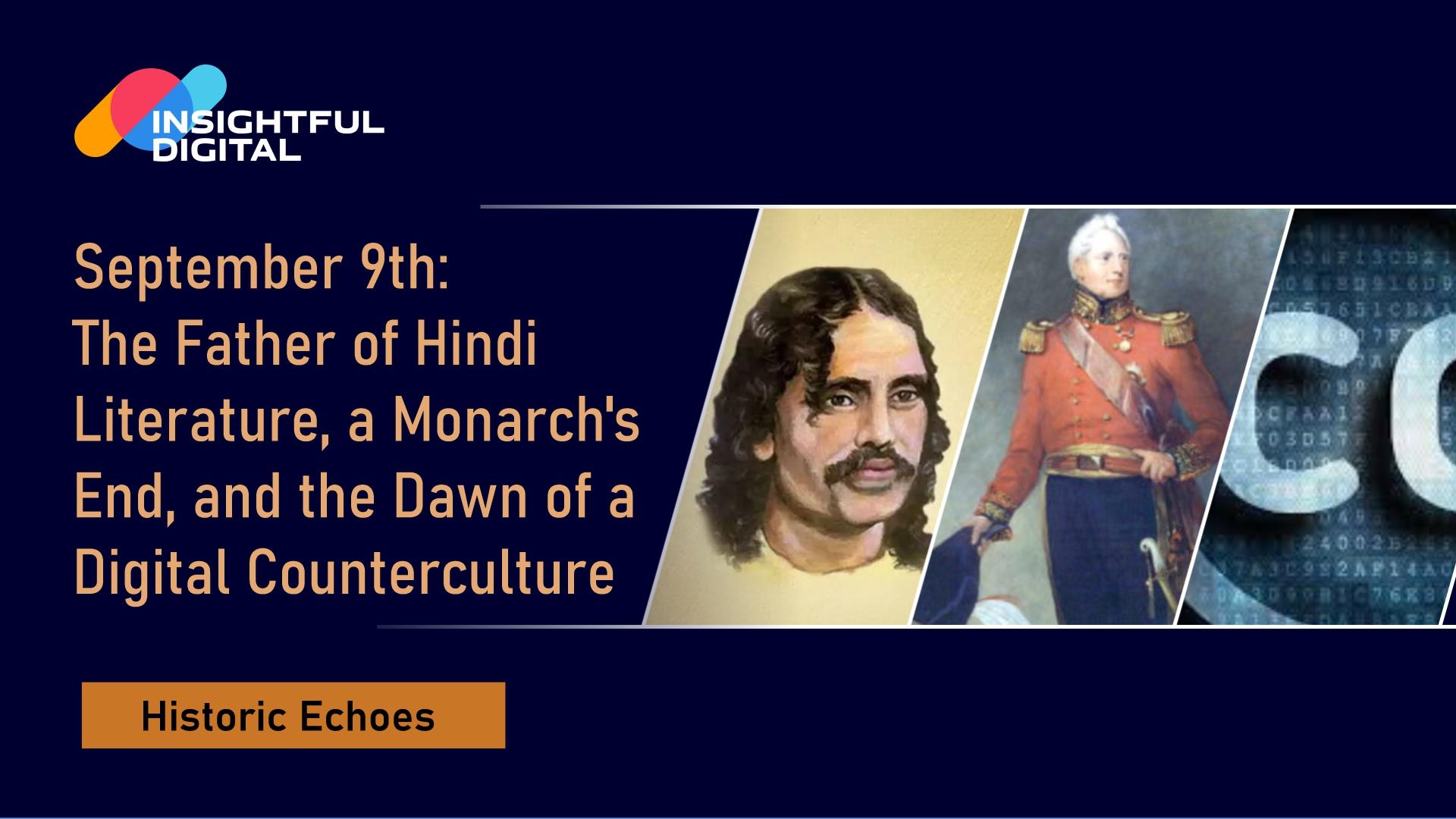
History is often shaped by singular individuals whose vision and sacrifice lay the foundation for future generations. September 9th is a date that pays homage to one such figure in India's cultural landscape—Bhartendu Harishchandra, the patriarch of modern Hindi. Yet, this same date also echoes with events of global significance: the passing of a king who embodied an era, and the birth of a project that would challenge the very nature of ownership and creativity in the digital age. It is a day that connects the renaissance of a language with the evolution of technology and the fall of an empire.
The Main Event: Bhartendu Harishchandra - The Architect of Modern Hindi
September 9th is observed as Bhartendu Harishchandra's Punya Tithi (death anniversary), a day to remember the man who is rightly called 'Bharatendu' (Moon of India) and the 'Father of Modern Hindi Literature.' His passing on this day in 1885, at the tragically young age of 35, marked the end of a brief but explosively productive life that permanently altered India's literary course.
1. The Renaissance Man of Kashi:
Born in 1850 in Varanasi, a cultural and religious epicenter, Harishchandra was immersed in a world of Sanskrit, Bengali, and Persian influences. He was not merely a writer; he was a playwright, a poet, a journalist, an editor, and a cultural critic. He recognized that for Hindi to thrive as a language of the people and the nation, it needed to break free from the confines of traditional, highly Sanskritized scholasticism and the emerging dominance of Urdu in official spheres.
2. Forging a New Linguistic Identity:
His genius lay in his ability to synthesize a new, accessible, and powerful literary language. He advocated for 'Khadi Boli' (the plain dialect) of Hindi, infusing it with a vocabulary that was both refined and widely understandable. This was a deliberate and political act—to create a modern prose that could serve as a unifying vehicle for social reform and national consciousness during the burgeoning freedom movement. Through his journals, 'Kavi Vachan Sudha' and ‘Harishchandra Magazine’, he provided a platform for this new Hindi and nurtured a generation of writers.
3. The Pioneer of Modern Theatre:
Bhartendu was arguably the first to lay the foundation of modern Hindi theatre. His plays were not just for entertainment; they were sharp social commentaries. Works like 'Andher Nagari' (City of Darkness), a satirical farce about a chaotic and corrupt state, remain stunningly relevant. 'Bharat Durdasha' (India's Misery) poignantly critiqued the societal and economic decay under British rule. He used drama as a mirror to hold up to society, sparking dialogue and awakening a sense of civic responsibility.
4. A Legacy of Purpose-Driven Art:
Bhartendu Harishchandra’s most enduring contribution was his ethos. His famous couplet encapsulates his life's mission:
"निज भाषा उन्नति अहै, सब उन्नति को मूल।"
(The progress of one's own language is the root of all progress.)
He believed that true national progress was impossible without cultural and linguistic self-confidence. He died young, likely from tuberculosis, but in his short life, he ignited a cultural awakening (the Hindi Nagari Renaissance) that would pave the way for literary giants like Premchand and the eventual recognition of Hindi as India's official language.
A Royal Passing: The End of the "Sailor King"
On September 9th, 1831, King William IV of the United Kingdom ascended to the throne following the death of his elder brother, George IV. While his coronation was not on this date, his accession marked a significant shift in British monarchy. Known as the "Sailor King" for his youthful naval career, William IV was seen as a more unpretentious and pragmatic monarch compared to his extravagant predecessor.
His reign, though short (1830-1837), was immensely consequential. It was during his time that the great Reform Act of 1832 was passed, a landmark piece of legislation that extended voting rights and reformed a deeply corrupt electoral system, taking a crucial step towards modern democracy. His death on June 20, 1837, brought his niece, Victoria, to the throne, ushering in the epoch-defining Victorian era. The accession on September 9th was the quiet beginning of this pivotal chapter.
The Digital Commons: The Birth of a Free Culture License
In a starkly different realm, September 9th, 2002, marks a pivotal moment in the digital revolution. On this day, the Creative Commons (CC) organization released its first set of free copyright licenses to the public.
This was a direct response to the increasingly restrictive nature of copyright law in the digital age, where the default was "all rights reserved." Creative Commons pioneered a new, flexible approach: "some rights reserved." These licenses allowed creators—artists, writers, educators, scientists—to easily grant permission for others to share, remix, and use their work legally, under conditions they themselves chose.
The launch of these licenses empowered the open-access movement, fueled collaborative projects like Wikipedia, and created a massive commons of reusable knowledge and creativity. It fundamentally challenged traditional notions of intellectual property and fostered a culture of sharing and collaboration that defines the internet's most productive and innovative corners.
Other Notable Events on September 9th
1850: California is admitted as the 31st state of the United States, cementing the legacy of the Gold Rush and dramatically altering the nation's geographic and economic balance.
1915: The United States begins its first-ever nationwide daylight saving time, a policy enacted during World War I to conserve energy.
1947: A critical early computer bug is recorded. Engineers found a moth trapped in a relay of the Harvard Mark II computer, taping it into the logbook with the note "First actual case of bug being found." This popularized the term "debugging."
Conclusion: The Unifying Thread of Empowerment
The events of September 9th, spanning centuries and continents, are united by a common theme: empowerment. Bhartendu Harishchandra sought to empower a nation through the modernization and elevation of its language. The political reforms of William IV's reign, beginning with his accession, empowered a new class of citizens through the vote. The Creative Commons movement empowered a generation of digital creators by freeing knowledge from restrictive copyright.
From the cultural shores of Varanasi to the halls of Westminster and the digital frontiers of the internet, September 9th stands as a testament to the human drive to open doors, share knowledge, and build a more accessible and progressive world. It is a day to remember that progress, in any field, is often the result of a visionary's courage to challenge the status quo.
Objective Questions for Competitive Exams
Q.1. Who is known as the 'Father of Modern Hindi Literature'?
a) Premchand
b) Bhartendu Harishchandra
c) Mahadevi Verma
Answer: b) Bhartendu Harishchandra
Q.2. Which famous play by Bhartendu Harishchandra satirizes corruption and chaos?
a) Bharat Durdasha
b) Andher Nagari
c) Chand Haseena
Answer: b) Andher Nagari
Q.3. In which year did Bhartendu Harishchandra pass away?
a) 1875
b) 1885
c) 1895
Answer: b) 1885
Q.4. King William IV of the UK was popularly called?
a) Farmer King
b) Sailor King
c) Merchant King
Answer: b) Sailor King
Q.5. Which reform act was passed during William IV’s reign?
a) Reform Act 1832
b) Reform Act 1919
c) Reform Act 1947
Answer: a) Reform Act 1832
Q.6. When was Creative Commons (CC) launched?
a) 1995
b) 2002
c) 2010
Answer: b) 2002
Q.7. Which online encyclopedia has been fueled by Creative Commons licenses?
a) Britannica Online
b) Wikipedia
c) Scholarpedia
Answer: b) Wikipedia
Q.8. Which U.S. state was admitted on September 9, 1850?
a) Texas
b) California
c) Florida
Answer: b) California
Q.9. What significant event in computing happened on September 9, 1947?
a) First computer virus
b) First recorded computer bug
c) First programming language
Answer: b) First recorded computer bug
Q.10. What is the unifying theme of the events on September 9th?
a) Empowerment
b) Warfare
c) Colonization
Answer: a) Empowerment