
Every year on September 5th, classrooms across India look a little different. There are handmade cards on desks, cultural programs on stage, and students trying (sometimes awkwardly) to play the role of their teachers. It feels fun, but also meaningful. The question is – where did this tradition actually begin? Was it only about Dr. Radhakrishnan, or does the idea go further back? The truth is, the respect for teachers has been around in India for centuries, much before the phrase “Teachers’ Day” came into being.
Ancient roots – Guru Purnima
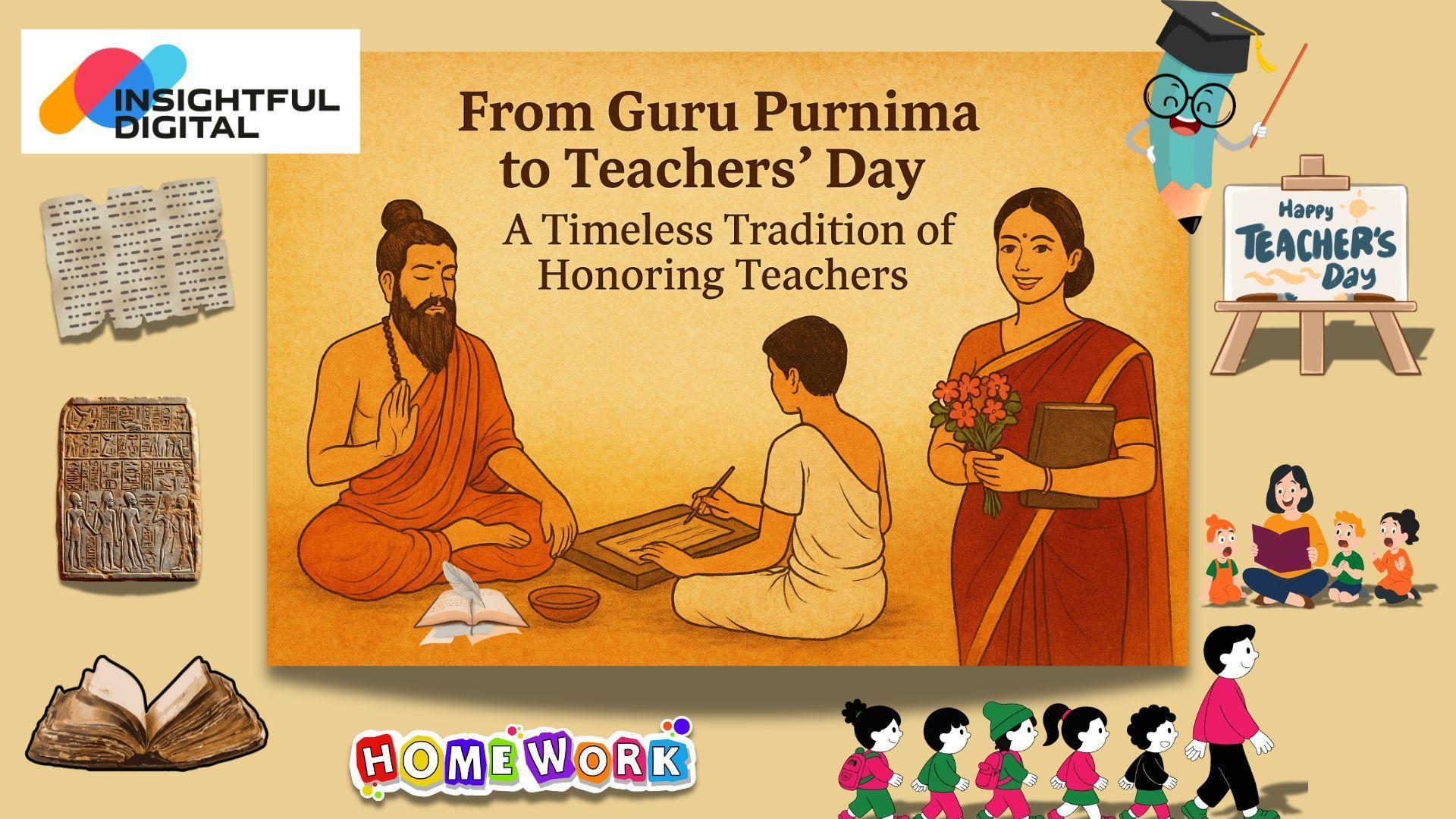
If you step back into ancient times, you’ll find that the guru held a place of honor in Indian society. A guru wasn’t just someone teaching lessons; he was seen as a guide for the entire journey of life. In the gurukul system, students literally lived with their teacher, learned discipline, values, and wisdom through everyday living.
There was even a dedicated day to express gratitude – Guru Purnima. This tradition is connected to Sage Vyasa, who gave India the Mahabharata and organized the Vedas. Buddhists remember it because Buddha delivered his first sermon on this day. Jains link it with Mahavira and his disciple Indrabhuti Gautam. Different religions, different stories, but the essence remained the same – thanking the teacher who shows the way.
Modern India – September 5th
Jump forward a few thousand years, and we see the tradition taking a modern form. In 1962, when students of Dr. Sarvepalli Radhakrishnan, India’s second President, wanted to celebrate his birthday, he suggested something remarkable – instead of focusing on him, dedicate the day to all teachers. That single idea transformed his birthday, 5th September, into India’s Teachers’ Day.
Interestingly, the world also recognized the need for such a day. UNESCO declared October 5th as World Teachers’ Day in 1994. This shows how universal the idea is – across cultures and countries, teachers are seen as the backbone of society.
Why this matters today
Now, you might wonder – in the age of Google, online courses, and AI, do we still need to celebrate teachers? Isn’t knowledge everywhere? The answer is yes; we need it more than ever. Because information is not wisdom. A teacher doesn’t just share facts; they help us make sense of them, guide our thinking, and sometimes even shape our dreams.
I still remember my own school days, when a simple word of encouragement from a teacher made me believe I could do more than I thought. That is something no search engine can do. And I’m sure many people have similar memories – a mentor, a coach, or even a boss who played that role of guiding light.
Beyond classrooms
When we think of Teachers’ Day, our minds go to schools and colleges. But the truth is, teachers exist everywhere. A parent, a friend, a senior at work – anyone who shares wisdom becomes a teacher in that moment. Honoring this day is really about recognizing that we never grow entirely on our own. Someone, somewhere, always lights the way for us.
Closing thought
Teachers’ Day is not just a function on the school calendar. It is a continuation of something India has valued since ancient times – the idea that knowledge is sacred, and those who give it deserve respect. From Guru Purnima under the banyan trees of old ashrams to September 5th in today’s modern classrooms, the message hasn’t changed. Gratitude to our teachers is timeless, and by keeping this tradition alive, we remind ourselves that every achievement we make rests on the shoulders of those who taught us.
MCQs for Readers:
Q1. Teachers’ Day in India is celebrated on which date every year.
a) 15th August
b) 5th September
c) 2nd October
d) 26th January
Answer: b) 5th September
Q2. Whose birthday is commemorated as Teachers’ Day in India?
a) Mahatma Gandhi
b) Dr. B.R. Ambedkar
c) Dr. Sarvepalli Radhakrishnan
d) Swami Vivekananda
Answer: c) Dr. Sarvepalli Radhakrishnan
Q3. Guru Purnima is traditionally associated with which sage?
a) Valmiki
b) Ved Vyasa
c) Patanjali
d) Vishwamitra
Answer: b) Ved Vyasa
Q4. UNESCO declared World Teachers’ Day in which year?
a) 1972
b) 1986
c) 1994
d) 2001
Answer: c) 1994
Q5. On which date is World Teachers’ Day celebrated globally?
a) 5th October
b) 10th November
c) 15th September
d) 1st December
Answer: a) 5th October
Q6. In the Gurukul system, what was the primary relationship between student and teacher?
a) Formal and contractual
b) Lifelong and sacred
c) Strictly academic
d) Only spiritual
Answer: b) Lifelong and sacred
Q7. Which religion links Guru Purnima with Buddha’s first sermon at Sarnath?
a) Hinduism
b) Buddhism
c) Jainism
d) Sikhism
Answer: b) Buddhism
Q8. The tradition of honoring teachers in India emphasizes:
a) Only classroom learning
b) Transfer of knowledge and values
c) Entertainment programs
d) Examination success
Answer: b) Transfer of knowledge and values