
When you’re starting a business, paperwork and registrations can feel overwhelming. One word you’ll hear again and again is GST. But what exactly is it, and why does it matter so much for entrepreneurs? Let’s break it down in a simple way.
So, what is GST?
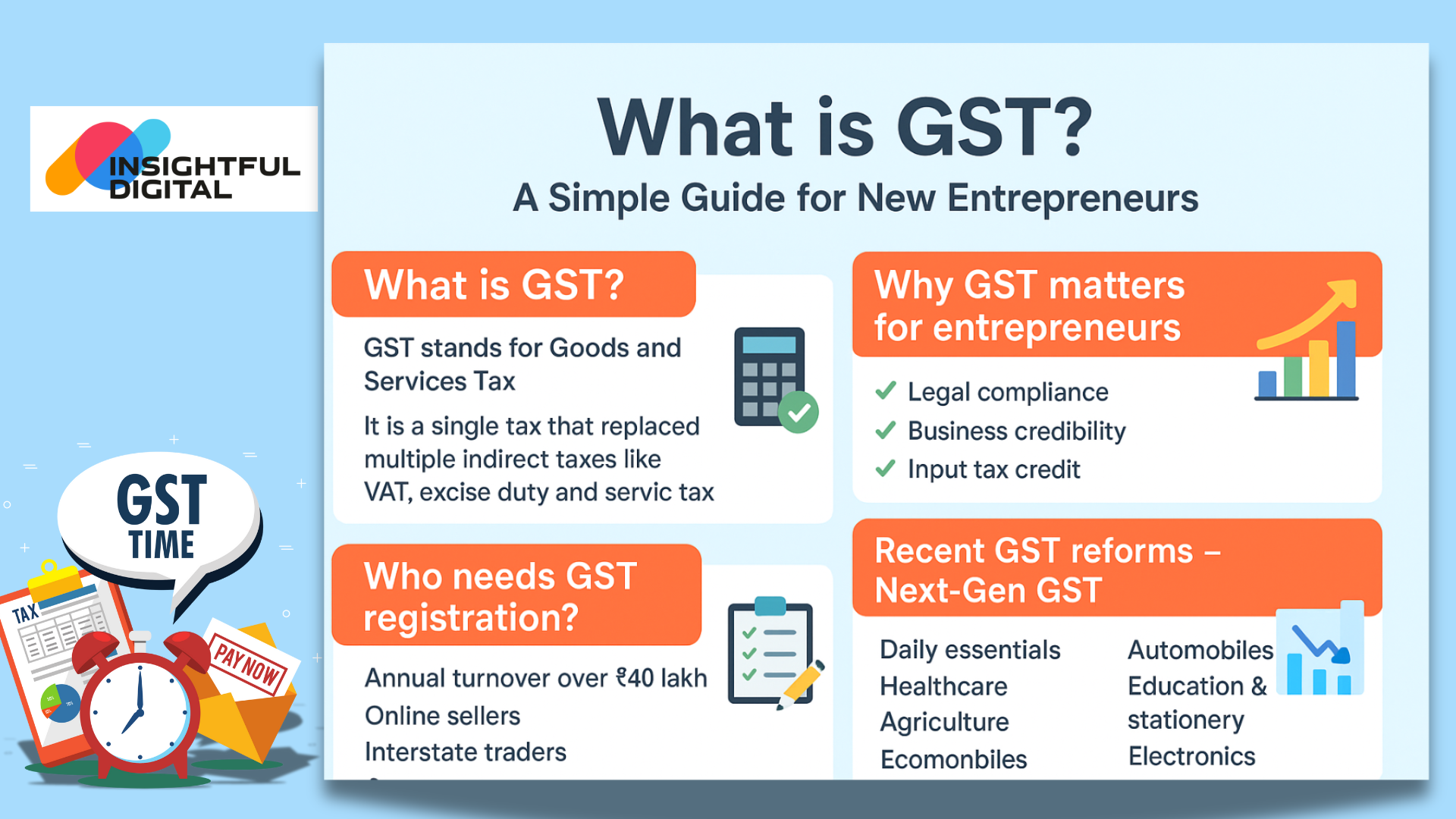
GST stands for Goods and Services Tax. It’s a single tax that replaced multiple indirect taxes in India. Instead of paying VAT, excise duty, and service tax separately, GST brings them under one umbrella. This makes the system cleaner, easier to manage, and more transparent.
Think of it like this – earlier, you had to juggle five different bills for a single purchase. Now, you just get one. That’s the role GST plays in business transactions.
Why GST matters for entrepreneurs
Let me share a quick example. One of my friends runs a small café. In the beginning, he didn’t register for GST because he thought – “I’m just starting, why complicate things?” But soon, customers (especially corporates) started asking for GST invoices. Without them, he lost a few bulk orders. That’s when he realized that having a GST number not only builds trust but also opens bigger opportunities.
For entrepreneurs, GST isn’t just a tax – it’s a badge of credibility. It shows that your business is recognized, accountable, and ready to work with larger clients.
Who needs GST registration?
Not every entrepreneur needs GST right away, but in many cases, it’s mandatory. Here’s when you must register:
If your annual turnover is more than ₹40 lakh (₹20 lakh for some special states).
If you’re running an online store (like through Amazon, Flipkart, or your own website).
If you provide interstate supply of goods or services.
If you’re an agent, distributor, or involved in e-commerce.
If you want to deal with government contracts or corporate clients (they usually require GST invoices).
Even if your business is smaller, you can choose voluntary registration. It helps build trust and allows you to claim input tax credit on purchases.
Recent GST reforms – making it simpler
The government recently announced Next-Gen GST reforms, calling it a “Diwali gift” for citizens and businesses. Here are a few highlights:
Daily essentials cheaper – GST on items like hair oil, toothpaste, napkins, and utensils has been reduced from 18%/12% to 5%.
Healthcare benefits – GST on medical oxygen, thermometers, spectacles, and test strips has dropped, making healthcare more affordable.
Support for farmers – Tractors, pesticides, and irrigation systems now attract just 5% GST instead of 12–18%.
Automobiles – Hybrid and small cars, two-wheelers, and goods vehicles now have reduced GST (from 28% to 18%).
Education & stationery – Maps, charts, notebooks, and pencils are either tax-free or at 5% only.
Electronics – Air conditioners, televisions, dishwashers, and monitors have seen cuts too.
On top of this, process reforms now allow faster registration (within three working days) and easier refunds, which is a big relief for startups and SMEs.
How to apply for GST
The process is now entirely online through the GST portal: www.gst.gov.in
You’ll need:
PAN card of the business or proprietor
Proof of business registration (like incorporation certificate)
Address proof of the business place
Bank account details
Aadhaar authentication
Once you apply, you usually get your GSTIN (GST Identification Number) within a few days.
Final thoughts
If you’re serious about your business, GST is not just a legal formality – it’s a growth tool. It helps you access bigger clients, saves you from penalties, and positions your business as credible and compliant.
So, whether you’re running a café, an online store, or a growing startup – don’t wait until someone asks you for a GST invoice. Get registered early, stay compliant, and let your business focus on scaling up.
MCQs for Competitive Exam: -
GST stands for:
a) General Sales Tax
b) Goods and Services Tax
c) Government Sales Tariff
d) Global Services Trade
Answer: b) Goods and Services Tax
Q2. GST was introduced in India in which year?
a) 2015
b) 2016
c) 2017
d) 2018
Answer: c) 2017
Q3. What is the turnover threshold for GST registration in most Indian states?
a) ₹10 lakh
b) ₹20 lakh
c) ₹40 lakh
d) ₹50 lakh
Answer: c) ₹40 lakh
Q4. For special category states, the GST registration threshold is:
a) ₹10 lakh
b) ₹20 lakh
c) ₹25 lakh
d) ₹30 lakh
Answer: b) ₹20 lakh
Q5. Which of the following businesses must mandatorily register for GST, regardless of turnover?
a) Local grocery shop
b) Freelance blogger
c) Online sellers on Amazon/Flipkart
d) small tailoring shop
Answer: c) Online sellers on Amazon/Flipkart
Q6. GST replaced which of the following taxes?
a) VAT
b) Excise Duty
c) Service Tax
d) All of the above
Answer: d) All of the above
Q7. Which recent reform reduced GST on hybrid cars from 28% to 18%?
a) GST 2.0
b) Next-Gen GST Reforms
c) New GST Code
d) Simplified GST Act
Answer: b) Next-Gen GST Reforms
Q8. Which GST rate is applied to daily essentials like toothpaste, hair oil, and napkins under the new reform?
a) 0%
b) 5%
c) 12%
d) 18%
Answer: b) 5%
Q9. What is the name of the unique number issued after successful GST registration?
a) TIN
b) PAN
c) GSTIN
d) DIN
Answer: c) GSTIN
Q10. GST registration can be completed through which website?
a) www.incometax.gov.in
b) www.cbic.gov.in
c) www.gst.gov.in
d) www.mca.gov.in
Answer: c) www.gst.gov.in
Q11. Under Next-Gen GST reforms, how soon can automatic registration be done?
a) 7 working days
b) 5 working days
c) 3 working days
d) 10 working days
Answer: c) 3 working days
Q12. Which of these is NOT a benefit of GST?
a) Input tax credit
b) Single indirect tax system
c) Easy compliance
d) Double taxation
Answer: d) Double taxation