
In the annals of history, certain dates become inextricably linked with the lives of transformative leaders. September 17th is one such date in India, celebrated as the birthday of Prime Minister Narendra Modi, a figure who has profoundly reshaped the nation's political and geopolitical landscape. Yet, the importance of this day extends beyond contemporary politics, reaching back to the very foundation of the world's largest democracy and out into the mysteries of our solar system. It is a day that connects charismatic leadership, democratic foundations, and scientific discovery.
The Main Event: Narendra Modi – The Architect of a New India
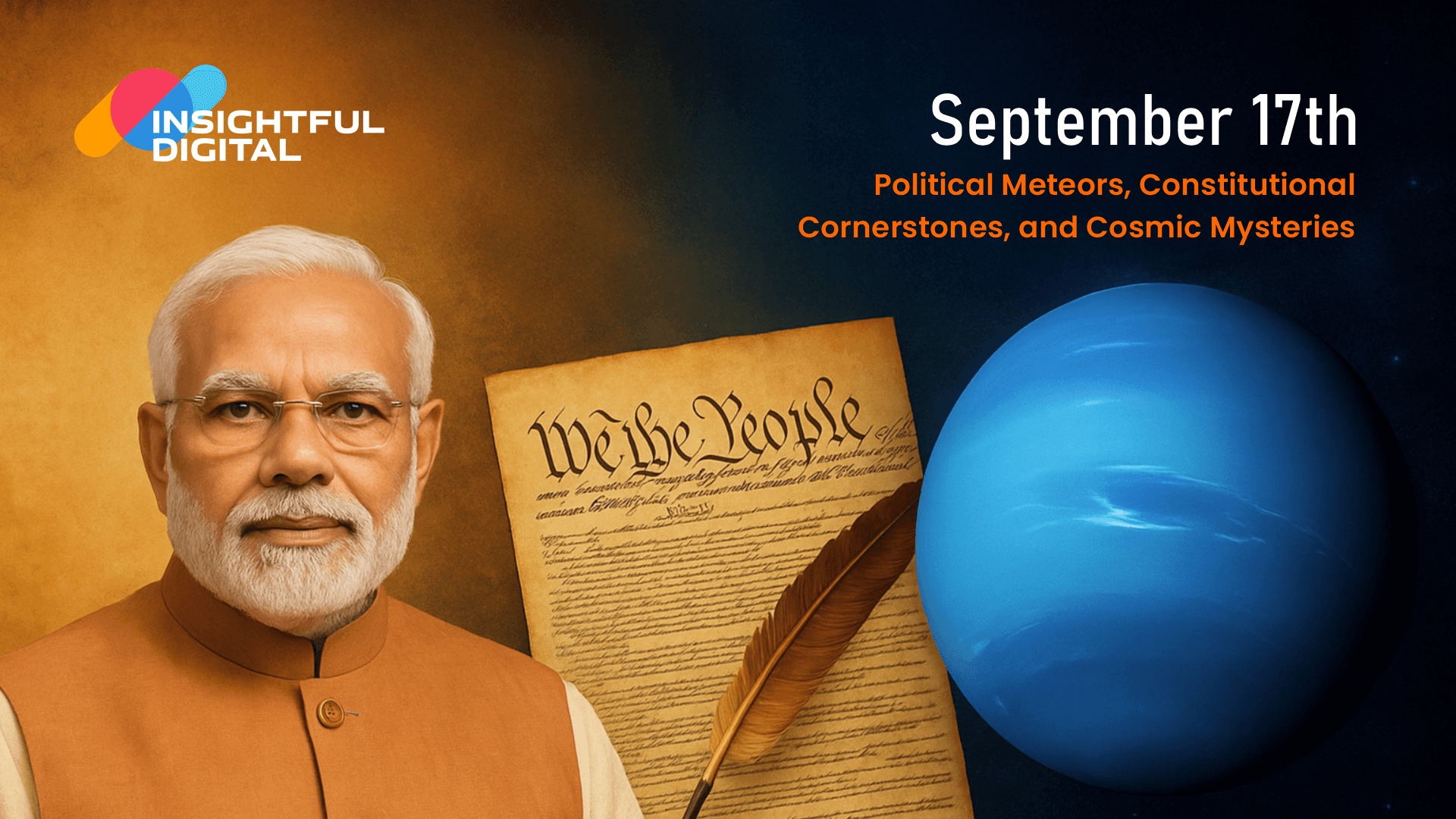
Born on September 17, 1950, in the small town of Vadnagar in Gujarat, Narendra Damodardas Modi's journey from a pracharak (campaigner) for the Rashtriya Swayamsevak Sangh (RSS) to the Prime Minister of India is a defining narrative of modern Indian politics. His birthday is not just a personal milestone but an occasion for his supporters and the ruling Bharatiya Janata Party (BJP) to celebrate his vision and leadership.
1. The Ascent: From Gujarat to India:
Modi's political identity was forged as a key strategist for the BJP in Gujarat, culminating in his appointment as Chief Minister of the state in 2001. His tenure, which lasted until 2014, was marked by both vigorous economic development and deep controversy, most notably the 2002 Gujarat riots. Supporters credit him with transforming Gujarat into an investment-friendly, infrastructure-rich model of governance ("The Gujarat Model"), while critics allege a breakdown of communal harmony. This period cemented his image as a strong, decisive, and polarizing leader.
2. The Pinnacle: Prime Ministership and a New Political Paradigm:
Leading the BJP to a historic victory in the 2014 general election, Modi became the 14th Prime Minister of India. His campaign, built on promises of development (Sabka Saath, Sabka Vikas), combating corruption, and instilling national pride, resonated with a young and aspirational India. His re-election in 2019 with an increased mandate confirmed his enduring popularity.
3. Key Contributions and Initiatives:
Economic and Welfare Reforms: The Goods and Services Tax (GST) aimed to unify India's complex tax system into a single market. Demonetization in 2016 was a shock move intended to curb black money and promote digital payments. Massive welfare schemes like the Pradhan Mantri Awas Yojana (Housing for All), Ujjwala Yojana (free LPG connections), and Jan Dhan Yojana (financial inclusion) have aimed to directly benefit the poor.
Foreign Policy and Global Stature: Modi has pursued an intensely proactive foreign policy, placing India firmly on the global stage. His personal diplomacy, engagement with world leaders, and advocacy for India's interests have significantly elevated the country's geopolitical profile. Initiatives like the International Day of Yoga have been recognized by the UN.
Infrastructure and Nationalism: His government has placed immense focus on infrastructure development, from highways and railways to the Statue of Unity, the world's tallest statue. His tenure has seen a pronounced emphasis on cultural nationalism and the rewriting of India's historical narrative to highlight its Hindu civilizational roots.
Social and Digital India: The Digital India campaign has pushed for a digitally empowered society, while the Startup India initiative has fostered entrepreneurship. The abrogation of Article 370, which granted special status to Jammu and Kashmir, was a historic move fulfilling a long-standing BJP promise.
4. The Enduring Legacy:
To his supporters, Modi is a visionary and strong leader who has restored India's pride, accelerated development, and empowered the masses. To his detractors, he is an authoritarian figure whose policies have exacerbated social divisions and economic inequality. Regardless of perspective, his impact on India's trajectory is undeniable, making his birthday a day of national significance and reflection.
The Foundation of a Nation: Signing of the U.S. Constitution
In a remarkable historical parallel, September 17th is also Constitution Day or Citizenship Day in the United States. On this day in 1787, the delegates to the Philadelphia Constitutional Convention signed the final draft of the U.S. Constitution.
This document, the oldest written national constitution still in operation, established the framework of the U.S. federal government, articulating a revolutionary system of checks and balances between its three branches. The signing on September 17th was the culmination of a long summer of fierce debate and compromise, resulting in a foundational text that has guided the American republic for over two centuries. The day serves as a counterpoint, reminding us that stable governance is built not just on charismatic leadership but on enduring institutional frameworks.
A Discovery That Redefined a Planet: The Neptune File
September 17th also marks a landmark achievement in scientific history. On this day in 1848, astronomer Johann Gottfried Galle of the Berlin Observatory, using calculations provided by French mathematician Urbain Le Verrier, became the first person to consciously identify the planet Neptune.
This was a monumental moment, as it was the first planet found by mathematical prediction rather than empirical observation. Le Verrier had calculated the position of this unknown planet based on perturbations in the orbit of Uranus. Galle’s confirmation was a stunning validation of Newtonian physics and human intellect, expanding our understanding of the solar system. It symbolizes the triumph of reason and calculation—a different kind of leadership that guides our exploration of the universe.
Other Notable Events on September 17th
1939: The Soviet Union invades Poland from the east, sixteen days after Nazi Germany's invasion from the west, effectively sealing Poland's fate and triggering the beginning of World War II in Europe.
1948: The United Nations mediator in Palestine, Count Folke Bernadotte, is assassinated by the Zionist militant group Lehi (the Stern Gang) in Jerusalem.
1978: The Camp David Accords are signed between Israeli Prime Minister Menachem Begin and Egyptian President Anwar Sadat, facilitated by U.S. President Jimmy Carter, a pivotal step towards peace in the Middle East.
Conclusion: The Interplay of Individual Will and Institutional Strength
September 17th presents a fascinating tapestry of human endeavor. It is a day that showcases the power of a single, determined individual to alter the destiny of a nation, as seen in the life of Narendra Modi. Simultaneously, it highlights the strength of collective wisdom and institutional design, embodied by the signing of the U.S. Constitution. And finally, it celebrates the pure power of the human mind to unlock the secrets of the cosmos, as with the discovery of Neptune.
Together, these events remind us that history is shaped by a complex interplay between charismatic force and constitutional order, between political vision and scientific discovery. September 17th is, therefore, not just a birthday celebration but a day to contemplate the many facets of power, leadership, and human achievement that continue to shape our world.
Objective Questions for Competitive Exams
Q1. In which town was Narendra Modi born?
a) Rajkot
b) Vadnagar
c) Ahmedabad
Answer: b) Vadnagar
Q2. Which year marked Narendra Modi’s birth?
a) 1949
b) 1950
c) 1952
Answer: b) 1950
Q3. Modi served as Chief Minister of which state before becoming Prime Minister?
a) Maharashtra
b) Gujarat
c) Uttar Pradesh
Answer: b) Gujarat
Q4. Which slogan is associated with Modi’s 2014 campaign?
a) Minimum Government, Maximum Governance
b) Sabka Saath, Sabka Vikas
c) Make in India Only
Answer: b) Sabka Saath, Sabka Vikas
Q5. Which policy sought to unify India’s indirect taxes into one system?
a) Demonetization
b) GST
c) PDS Reform
Answer: b) GST
Q6. The abrogation of which Article removed special status for Jammu and Kashmir?
a) Article 356
b) Article 370
c) Article 35A only
Answer: b) Article 370
Q7. The U.S. Constitution was signed on September 17 of which year?
a) 1776
b) 1787
c) 1791
Answer: b) 1787
Q8. Which principle is central to the U.S. Constitution’s structure?
a) Unitary executive only
b) Checks and balances among three branches
c) Direct democracy in all matters
Answer: b) Checks and balances among three branches
Q9. Who provided the calculations that led to Neptune’s identification?
a) Isaac Newton
b) Urbain Le Verrier
c) Galileo Galilei
Answer: b) Urbain Le Verrier
Q10. Which astronomer is credited with the first conscious observation of Neptune on September 17?
a) Johann Gottfried Galle
b) William Herschel
c) Edwin Hubble
Answer: a) Johann Gottfried Galle
Q11. On September 17, 1939, which nation invaded Poland from the east?
a) Germany
b) Italy
c) The Soviet Union
Answer: c) The Soviet Union
Q12. The Camp David Accords were signed in which year?
a) 1973
b) 1978
c) 1982
Answer: b) 1978