
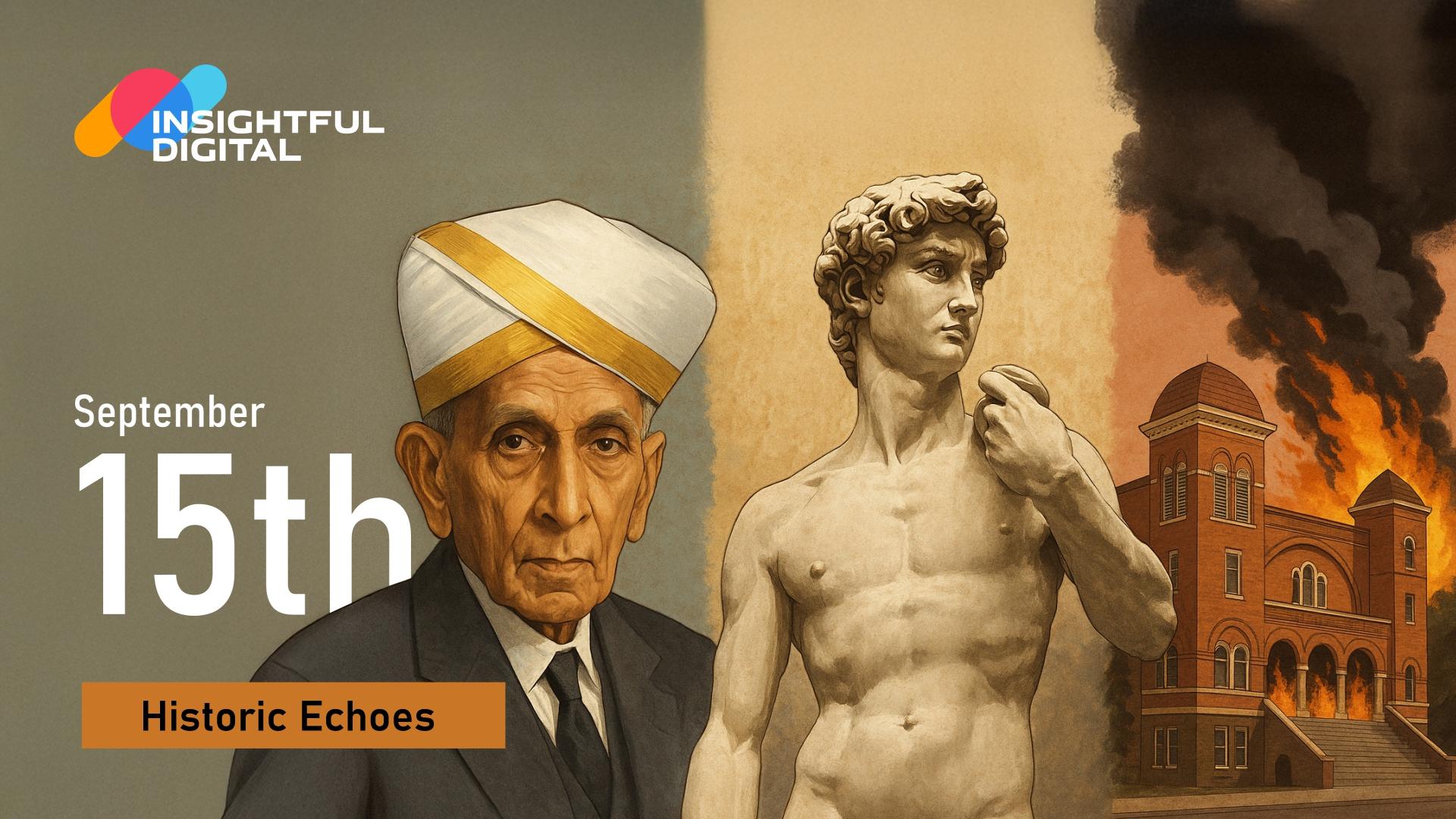
Certain dates are reserved for honoring the architects of our modern world—the visionaries whose calculations and constructions form the very bedrock of contemporary life. September 15th is one such day, recognized across India as Engineers' Day in homage to one of the greatest nation-builders the country has ever produced, Sir Mokshagundam Visvesvaraya. However, the significance of this date extends beyond engineering marvels, also marking a seminal moment in Western art history and a tragic turning point in American socio-political life. It is a day that celebrates the application of intellect to material problems, the explosion of creative genius, and a sobering reminder of the cost of hatred.
The Main Event: Engineers' Day and the Legacy of Sir M. Visvesvaraya
September 15th is the birth anniversary of Bharat Ratna Sir Mokshagundam Visvesvaraya (1861-1962), a luminary whose life and work are synonymous with engineering excellence, integrity, and transformative nation-building.
1. The Engineer as Nation-Builder:
Visvesvaraya's career was a masterclass in using engineering as a tool for economic development and public welfare. At a time when India was under colonial rule, his projects were not merely technical feats; they were assertions of self-reliance and foresight.
Krishna Raja Sagara Dam (Karnataka): His most iconic creation, this dam was a pioneering marvel. He introduced and implemented innovative techniques like automatic sluice gates and a unique block irrigation system. The dam transformed the arid Mysore region into a fertile belt, catalyzing agriculture and prosperity.
Flood Protection System (Hyderabad): He designed and executed a complex and effective flood protection system for the city of Hyderabad, saving it from the perennial devastation of the Musi River.
Chief Engineer of Mysore State: As the Diwan (Prime Minister) of Mysore, he transcended his technical role. He was the chief architect of the state's industrialisation, establishing the Mysore Soap Factory, the Parasitoid Laboratory, the Mysore Iron and Steel Works (Bhadravati), and even the State Bank of Mysore. He was instrumental in founding the Government Engineering College in Bangalore, now named the University Visvesvaraya College of Engineering (UVCE) in his honor.
2. The Unwavering Ethos of Quality and Discipline:
Sir MV was renowned for his meticulous precision, unwavering discipline, and absolute integrity. Legend has it that he would measure the distance between two nails on a chair to ensure they met specifications. This ethos of "right first time" and zero tolerance for corruption became his defining characteristic, setting a benchmark for all Indian engineers.
3. Why Engineers' Day?
The nation observes Engineers' Day on his birthday not just to remember his projects, but to celebrate the ethos he embodied. He exemplified how engineering is a profession dedicated to public service, economic advancement, and improving human life. His life is a reminder that true engineering is about building a better society, brick by brick, calculation by calculation.
The Birth of a Masterpiece: Michelangelo's David
On September 15th, 1504, one of the most iconic sculptures in human history, Michelangelo's David, was unveiled to the public in Florence's Piazza della Signoria. This event was far more than an artistic exhibition; it was a powerful political and cultural statement.
Carved from a single, discarded block of Carrara marble that other sculptors had deemed unusable, David represented the pinnacle of Renaissance ideals. Unlike previous depictions of David after his victory, Michelangelo chose to capture the moment before the battle—tense, focused, and embodying the perfect balance of idealized beauty, humanist strength, and nervous energy.
For the Florentine Republic, the statue was instantly adopted as a symbol of their own defiance against larger, powerful rivals. Just as the biblical David stood against Goliath, Florence saw itself as a small but resilient republic standing against giants. The unveiling on this day cemented the shift in art from mere decoration to an expression of intellectual, political, and civic power.
A Day of Tragedy: The 16th Street Baptist Church Bombing
September 15th, 1963, marks one of the darkest days of the American Civil Rights Movement. In a horrific act of racial terrorism, members of the Ku Klux Klan planted a bomb under the steps of the 16th Street Baptist Church in Birmingham, Alabama.
The explosion killed four young African-American girls: Addie Mae Collins (14), Cynthia Wesley (14), Carole Robertson (14), and Denise McNair (11). They were in the church's basement, preparing for the Youth Day service. The brutality of the act—targeting children in a place of worship—sent a shockwave across the nation and the world.
This tragedy did not break the movement; it galvanized it. The outrage it generated proved to be a pivotal turning point, building massive public support that was crucial for the passage of the landmark Civil Rights Act of 1964, which outlawed discrimination based on race, color, religion, sex, or national origin. The event is a permanent scar and a solemn reminder of the violent cost of hatred and the enduring struggle for equality.
Other Notable Events on September 15th
1916: The first use of tanks in warfare during World War I, by the British Army at the Battle of the Somme, marking a revolution in military technology.
1935: The Nuremberg Laws are enacted in Nazi Germany, stripping Jewish citizens of their citizenship and laying the legal groundwork for the Holocaust. This stands as a stark historical bookend to the Birmingham bombing, showing the global pervasiveness of institutionalized bigotry.
2008: The investment bank Lehman Brothers files for Chapter 11 bankruptcy, the largest in U.S. history, triggering a global financial crisis and the Great Recession—a failure of financial "engineering" with worldwide consequences.
Conclusion: The Duality of Human Endeavor
September 15th presents a profound duality at the heart of the human experience. On one hand, it is a day to celebrate the heights of human creativity and intellect—the structural genius of Sir M. Visvesvaraya that harnesses nature for the good of society, and the artistic genius of Michelangelo that captures the human spirit in stone.
On the other hand, it forces a reckoning with the depths of human cruelty, as witnessed in the racist bombing in Birmingham. This contrast is not a coincidence but a essential lesson. It reminds us that the same capacity for reason and creation that builds dams and sculpts masterpieces can be perverted by ignorance and hatred to destroy lives.
Therefore, Engineers' Day is not just about celebrating technical achievement. It is, as Sir MV himself demonstrated, a call to harness knowledge, precision, and discipline for the unequivocal betterment of humanity. It is a day to commit to building a world where the bombs of bigotry are forever defused by the enduring structures of justice, equality, and enlightened progress.
Objective Questions for Competitive Exams
Q.1. Engineers’ Day in India is celebrated on whose birth anniversary?
a) Dr. A.P.J. Abdul Kalam
b) Sir Mokshagundam Visvesvaraya
c) Homi J. Bhabha
Answer: b) Sir Mokshagundam Visvesvaraya
Q.2. Which landmark project is most closely associated with Sir M. Visvesvaraya?
a) Hirakud Dam
b) Krishna Raja Sagara Dam
c) Sardar Sarovar Dam
Answer: b) Krishna Raja Sagara Dam
Q.3. Sir MV served as the Diwan (Prime Minister) of which princely state?
a) Travancore
b) Mysore
c) Baroda
Answer: b) Mysore
Q.4. Which innovation is credited to Sir MV in dam engineering?
a) Arch dam design
b) Automatic sluice gates
c) Gravity dam spillways only
Answer: b) Automatic sluice gates
Q.5. Michelangelo’s David symbolizes which city-state’s political spirit?
a) Venice
b) Florence
c) Rome
Answer: b) Florence
Q.6. The 16th Street Baptist Church bombing occurred in which U.S. city?
a) Selma, Alabama
b) Montgomery, Alabama
c) Birmingham, Alabama
Answer: c) Birmingham, Alabama
Q.7. The victims of the 1963 church bombing were primarily:
a) Young girls preparing for Youth Day
b) Civil rights leaders in a meeting
c) Visiting choir members from another state
Answer: a) Young girls preparing for Youth Day
Q.8. Which landmark U.S. law gained crucial momentum after the 1963 bombing?
a) Voting Rights Act of 1965
b) Civil Rights Act of 1964
c) Fair Housing Act of 1968
Answer: b) Civil Rights Act of 1964
Q.9. Which military technology saw its first battlefield use on September 15, 1916?
a) Submarines
b) Tanks
c) Fighter jets
Answer: b) Tanks
Q.10. The Nuremberg Laws enacted on September 15, 1935 primarily targeted:
a) Political dissenters
b) Jewish citizens
c) Foreign workers
Answer: b) Jewish citizens
Q.11. Which financial institution’s collapse on September 15, 2008 triggered a global crisis?
a) Bear Stearns
b) Lehman Brothers
c) Washington Mutual
Answer: b) Lehman Brothers
Q.12. The overarching theme connecting the events of September 15th is:
a) Exploration
b) Empowerment and accountability
c) Isolationism
Answer: b) Empowerment and accountability