
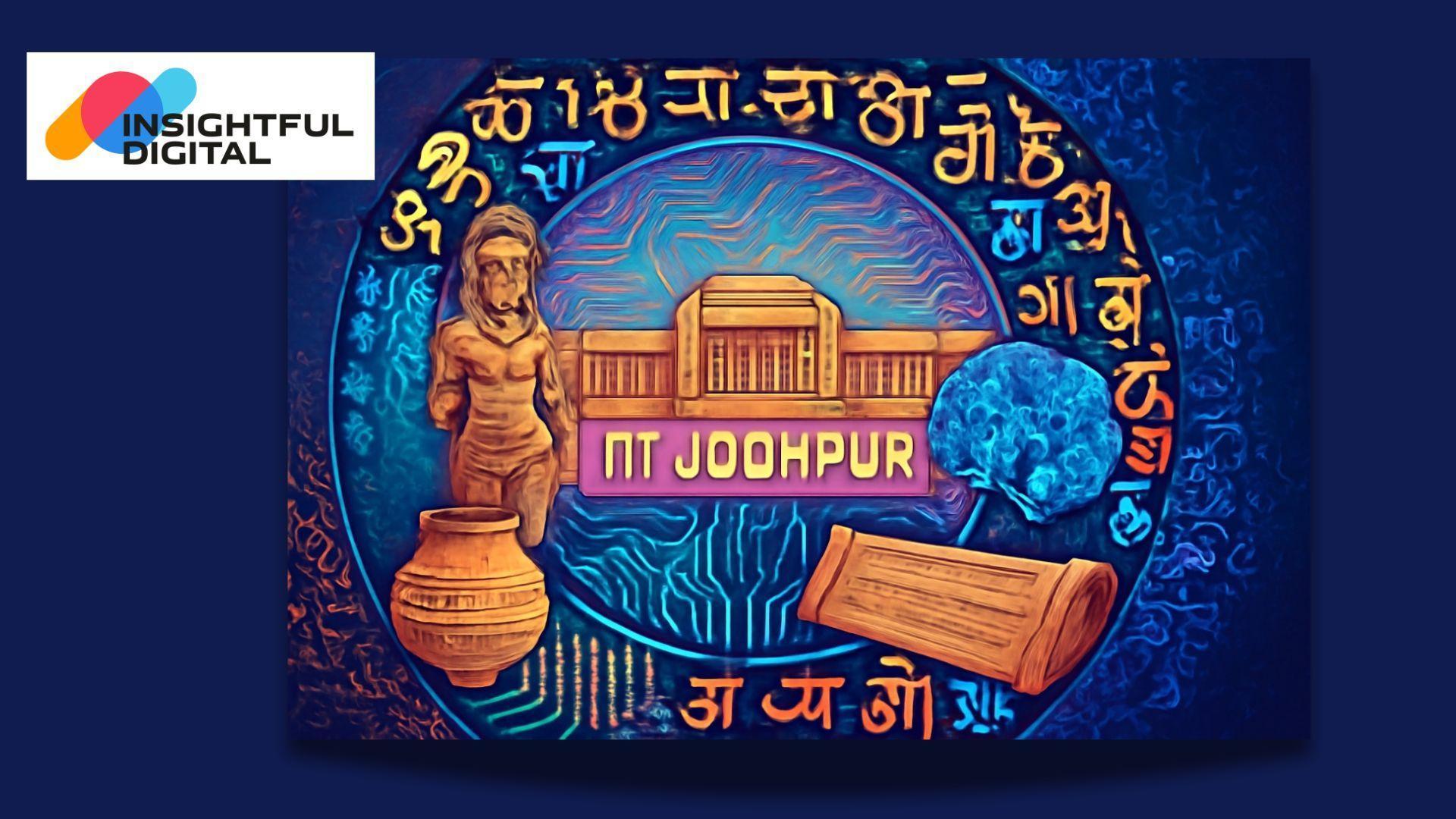
India is noisy with languages. Step into one city and you’ll hear Hindi, travel a few hours away and you may find yourself surrounded by Tamil, Bengali, or Marathi. This diversity is beautiful but also tricky when it comes to technology. Most digital tools are built for English first. That’s where IIT Jodhpur’s Vision, Language and Learning Group (VL2G) comes into the picture. Led by Professor Anand Mishra, the group is experimenting with ways AI can actually serve Indian users – not just copy global trends.
AI that reads our scripts
Have you ever clicked a picture of a shop board or a road sign and wished your phone could instantly tell you what it means? The team at IIT Jodhpur has built something close to that dream. They created open-source APIs for scene text recognition. Put simply, this lets AI read text inside an image, even if it’s written in Indian scripts.
And here’s the part that makes it stand out – it doesn’t stop at Hindi or English. The system can handle 13 languages including Telugu, Tamil, Bengali, Assamese, Malayalam, Urdu and more. Imagine what this means for travelers, students, or even businesses trying to reach people across regions. Because it’s open-source, anyone can build on top of it. A startup can plug it into an app, a developer can tweak it for education, or a tourism company can use it to help visitors move around with ease.
Saving fragile manuscripts
Now let’s move from modern signboards to something centuries old. India has thousands of manuscripts written in Sanskrit, Pali, and other classical languages. Many of them are fragile, fading, or locked in archives. Without care, they risk disappearing forever.
To fix this, IIT Jodhpur has partnered with the Indira Gandhi National Centre for the Arts (IGNCA) and TIH-iHUB Drishti Foundation. Their idea is simple – use AI tools to restore and digitize these works. Old pages are cleaned digitally, handwriting is enhanced, and OCR makes the texts searchable. The outcome – a student in 2040 could pull up a rare manuscript from their laptop instead of trying to access a damaged original in some archive. That’s cultural preservation with technology at its core.
Smarter video AI
Languages and manuscripts are not the only focus. The VL2G team is also diving into video understanding. With support from Accenture Labs, they’ve developed a model that can detect and track objects in videos – even ones it hasn’t been trained on before.
Think of the uses. In a factory, it could spot unsafe behavior in real time. In hospitals, it could help assess medical trainees as they practice. In classrooms, it might evaluate how students perform lab work. The same technology could expand into surveillance, logistics or even smart manufacturing. It’s not just theory – these are use cases industries can adopt in the near future.
Why these matters
Most AI work globally is tuned for English-speaking users. That leaves a big gap for communities whose languages rarely show up in training data. IIT Jodhpur’s approach is different – it begins with India’s own needs. By building APIs for Indian scripts and by rescuing old manuscripts, they are making AI feel relevant and accessible.
It also tells us something about the direction of technology. Innovation doesn’t have to ignore tradition. You can build futuristic video models while also protecting a 500-year-old Sanskrit text. Both matter, and both can be done side by side.
Wrapping up
IIT Jodhpur’s projects show that AI is not only about smarter machines – it can also be about smarter societies. Reading a road sign in an unfamiliar script, studying a rare manuscript online, or improving worker safety with real-time video analysis – these are not small wins. Together, they point to a larger vision: technology that respects culture while driving progress.
MCQs for Readers:
Which IIT is leading the AI initiative focused on Indian languages and cultural heritage?
a) IIT Bombay
b) IIT Delhi
c) IIT Jodhpur
d) IIT Kanpur
Answer: c) IIT Jodhpur
Who leads the Vision, Language and Learning Group (VL2G) at IIT Jodhpur?
a) Prof. Anand Mishra
b) Prof. Rajeev Sinha
c) Prof. Ashok Gupta
d) Prof. Ramesh Kumar
Answer: a) Prof. Anand MishraHow many Indian languages are currently supported by the scene text recognition APIs developed at IIT Jodhpur?
a) 10
b) 13
c) 15
d) 20
Answer: b) 13Which organizations are IIT Jodhpur collaborating with to digitize manuscripts?
a) NITI Aayog and DRDO
b) IGNCA and TIH-iHUB Drishti Foundation
c) ISRO and C-DAC
d) NCERT and AICTE
Answer: b) IGNCA and TIH-iHUB Drishti FoundationWhat technology is used to make old manuscripts searchable in digital format?
a) Machine Translation
b) Optical Character Recognition (OCR)
c) Speech Recognition
d) Blockchain
Answer: b) Optical Character Recognition (OCR)Which global company has partnered with IIT Jodhpur for video-understanding AI models?
a) Microsoft
b) Accenture Labs
c) Google Research
d) IBM Watson
Answer: b) Accenture LabsWhat is the unique feature of IIT Jodhpur’s video AI model?
a) Works only on English subtitles
b) Can track unseen objects
c) Uses blockchain for storage
d) Limited to healthcare sector
Answer: b) Can track unseen objectsWhat broader national project is IIT Jodhpur’s work aligned with?
a) Digital India Mission
b) Startup India
c) Bhashini Project
d) Make in India
Answer: c) Bhashini ProjectWhich of the following is NOT among the languages supported by IIT Jodhpur’s text recognition APIs?
a) Hindi
b) Tamil
c) Spanish
d) Bengali
Answer: c) SpanishWhat is the key vision behind IIT Jodhpur’s AI initiatives?
a) Create English-only AI tools
b) Replace traditional heritage
c) Build inclusive, culture-aware technology
d) Focus only on robotics
Answer: c) Build inclusive, culture-aware technology