
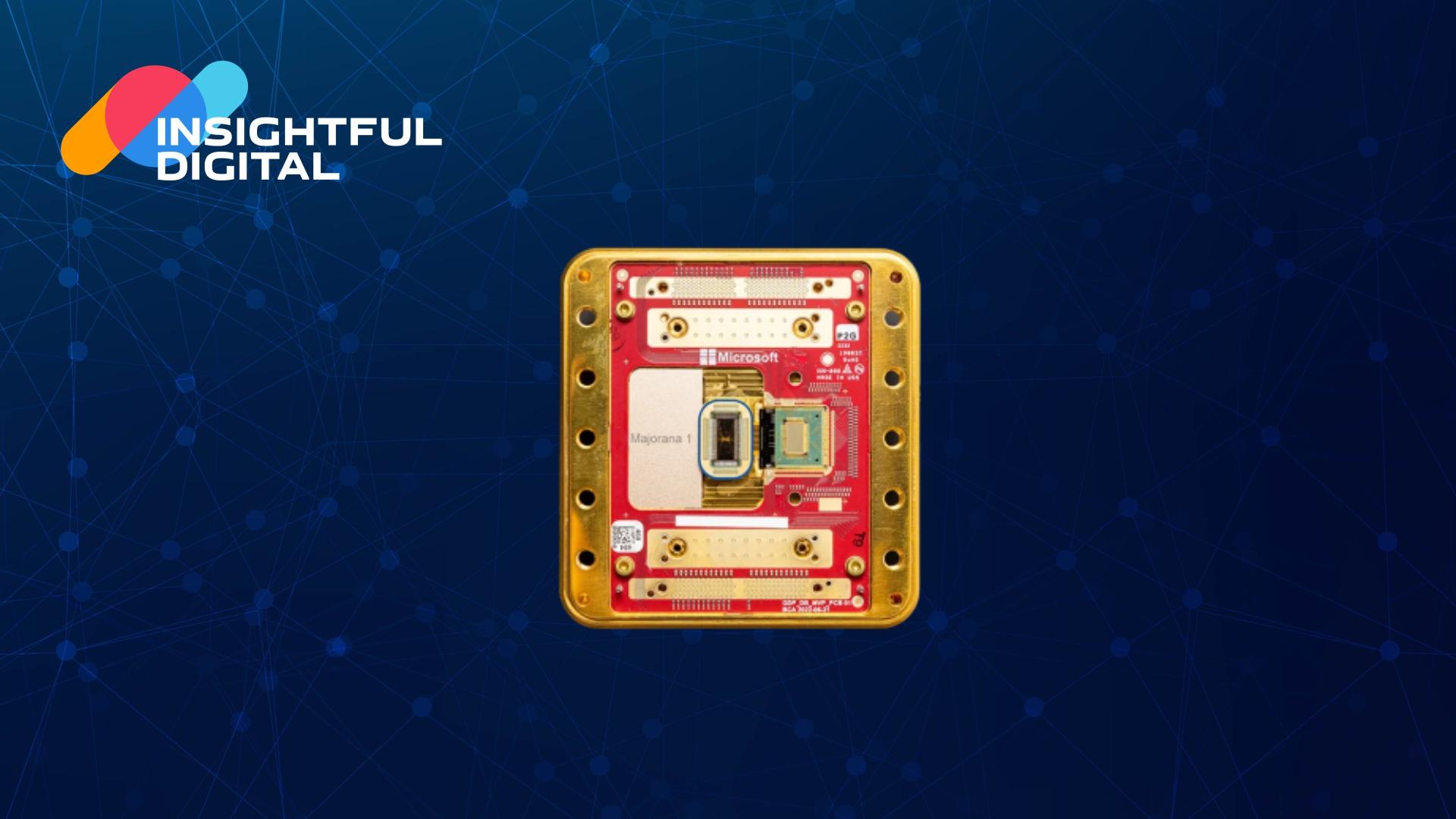
Microsoft has taken a bold leap into the future of quantum computing with the unveiling of Majorana 1, a pioneering quantum chip that introduces the use of topological qubits. Unlike traditional quantum systems plagued by instability and high error rates, this chip harnesses the stability of a new quantum state known as the topological superconductor—making scalable, error-resistant quantum computing closer to reality.
What Makes Majorana 1 a Breakthrough in Quantum Technology?
Traditional quantum computing relies on fragile qubits that are highly susceptible to environmental noise, requiring sophisticated and resource-heavy error correction. Microsoft’s Majorana 1 breaks this barrier by deploying topological qubits formed using Majorana zero modes—exotic quasiparticles theorized to exist in certain superconducting materials. These qubits are inherently more stable, allowing quantum states to remain coherent for longer periods.
This innovative approach could drastically reduce the number of physical qubits needed for error correction, unlocking the possibility of building fault-tolerant quantum computers that can perform real-world calculations at scale.
Scalability: The Next Frontier in Quantum Computing
The key advantage of the Majorana 1 chip lies in its scalability. Microsoft envisions a future where millions of qubits can be integrated on a single quantum processor. This is crucial because the true computational power of quantum systems emerges only when vast numbers of qubits operate in parallel with minimal error.
Unlike conventional designs, adding more qubits to the Majorana 1 architecture doesn’t proportionally increase the complexity or instability. This makes the platform ideal for tackling large-scale applications such as climate simulation, drug discovery, cryptography, and materials science.
Fully Digital Control: A Simpler Path to Quantum Stability
Most quantum processors today require precise analog tuning of each qubit—making them hard to scale and control. Majorana 1 takes a digital-first approach by using voltage pulses to manipulate qubit states. This fully digital control system minimizes the need for analog components and reduces operational complexity, making quantum circuits easier to build and run at scale.
By using this digital control mechanism, Microsoft has taken a significant step in transforming quantum computing from lab-based prototypes to industrial-grade solutions that are easier to maintain and replicate.
Why Majorana 1 Matters for the Future of Quantum Computing
If the Majorana 1 chip performs as expected, it will be a major step toward solving real-world problems that classical computers cannot. For instance, simulating molecular interactions for pharmaceutical development or breaking traditional cryptographic codes could become possible. It also lays the foundation for quantum AI systems that may one day surpass today’s deep learning algorithms.
Microsoft’s strategy is unique because it doesn’t just focus on building faster quantum computers, but more reliable, efficient, and scalable ones. Years of research in quantum physics, materials science, and software development have culminated in this single chip that could one day rival classical supercomputers across industries.
Key Highlights of Microsoft’s Majorana 1 Quantum Chip
Why in News: Microsoft announced the Majorana 1 chip, a quantum processor using topological qubits.
Core Innovation: Uses topological superconductors to create stable qubits with reduced error.
Scalability: Designed to scale to millions of qubits, enabling high-performance quantum computing.
Control Mechanism: Employs fully digital voltage pulses instead of analog tuning for better efficiency.
Future Impact: Could revolutionize cryptography, materials science, AI, and complex simulations.
Objective Questions for Competitive Exams
Q.1. What is the name of Microsoft's newly introduced quantum chip?
a) Azure Q1
b) Majorana 1
c) QuantaCore
Answer: b) Majorana 1
Q.2. Which type of qubits does Majorana 1 use?
a) Classical qubits
b) Photonic qubits
c) Topological qubits
Answer: c) Topological qubits
Q.3. What is a key advantage of topological qubits used in Majorana 1?
a) They generate more heat
b) They are more error-prone
c) They are more stable and reduce error correction needs
Answer: c) They are more stable and reduce error correction needs
Q.4. What kind of control system is used in the Majorana 1 chip?
a) Analog frequency modulation
b) Manual tuning
c) Fully digital voltage pulse control
Answer: c) Fully digital voltage pulse control
Q.5. What is a potential application of large-scale quantum computing enabled by Majorana 1?
a) Word processing
b) Web development
c) Molecular simulation for drug discovery
Answer: c) Molecular simulation for drug discovery
Q.6. What state of matter is used in Majorana 1 to create qubits?
a) Bose-Einstein Condensate
b) Topological Superconductor
c) Quantum Plasma
Answer: b) Topological Superconductor