
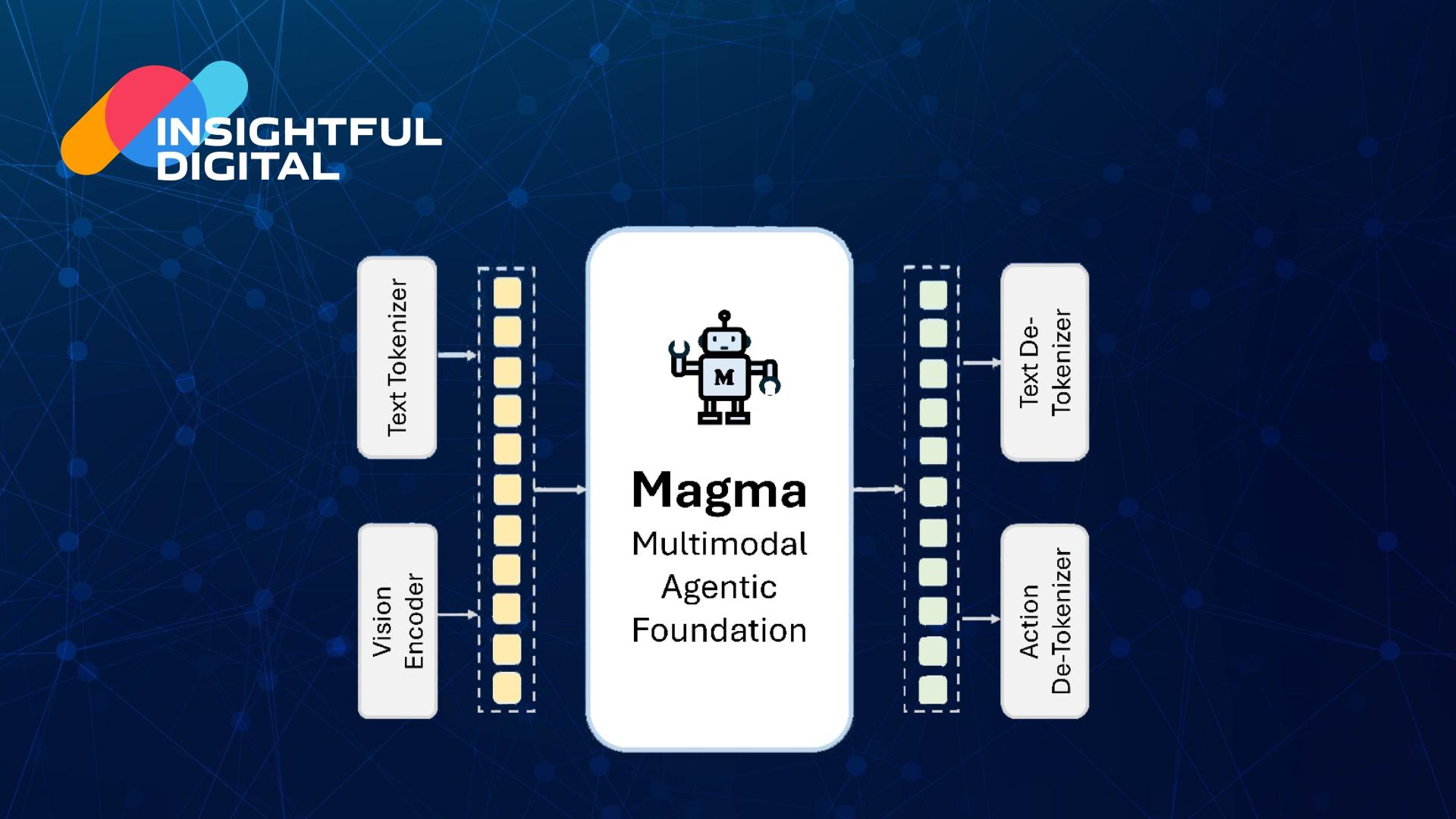
Microsoft has introduced Magma, a next-generation multimodal AI model designed to understand and interact with both visual and linguistic information in real-world settings. Unlike traditional AI models, Magma can analyze images, read texts, and physically interact with its environment through robotic control or digital navigation.
What Sets Magma Apart?
While most vision-language (VL) models focus only on interpreting image-text combinations, Magma goes further by embedding spatial intelligence. This allows it not just to understand, but also to act — making it capable of navigating digital interfaces and manipulating objects with robotic arms.
Core Features of Magma
1. Multimodal Understanding: Processes text and images together for deeper comprehension.
2. Spatial Intelligence: Understands physical context and makes decisions accordingly.
3. Robotic Manipulation: Executes real-world tasks using robotic precision.
4. UI Navigation: Identifies clickable elements and performs actions like sending messages or toggling settings.
5. Enhanced Accuracy: Outperforms previous models in real-world and digital task performance.
From Vision-Language to Multimodal AI
Conventional VL models are limited to matching images with text. Magma evolves this concept by integrating motion tracking, predictive logic, and interaction capabilities. It combines verbal intelligence (understanding language and text) with spatial reasoning (predicting physical movements).
How Was Magma Trained?
Magma was trained on a diverse multimodal dataset, including:
- Images: Identifying and labeling interface elements.
- Videos: Observing how objects move and interact over time.
- Robotics Data: Learning how to control mechanical limbs.
Two labeling techniques were key:
- Set-of-Mark (SoM): Used to recognize interactive UI elements.
- Trace-of-Mark (ToM): Helped understand motion patterns in robotics and video frames.
Real-World Capabilities of Magma
1. UI Navigation
Magma can seamlessly navigate applications and execute tasks like:
- Checking live weather updates.
- Switching on/off airplane mode.
- Sharing digital content.
- Sending messages through messaging platforms.
2. Robotic Interaction
In robotic tasks, Magma excels at:
- Manipulating soft or fragile objects.
- Grabbing and placing objects in new locations.
- Adjusting to new tools and surroundings with minimal retraining.
3. Spatial Reasoning
Despite using less data than GPT-4o, Magma performs better in spatial reasoning tasks. It can predict future scenarios and adapt its actions in real-time — a critical ability for robotics and automation.
4. Video and Multimodal Comprehension
Magma excels in understanding videos and multimodal instructions, outperforming models like Video-LLaMA2 and ShareGPT4Video. This makes it a valuable model for applications involving visual storytelling or video analysis.
Future Impact of Magma
With its unique ability to "see," "understand," and "act," Magma could revolutionize:
- AI personal assistants that perform real-world tasks.
- Smart homes with AI-powered robotic systems.
- Healthcare assistants for elderly or physically challenged individuals.
- Industrial automation using autonomous navigation and control systems.
Summary of Key Aspects
| Aspect | Details |
|---|---|
| Why in News? | Microsoft introduced Magma, a multimodal AI capable of real-world actions. |
| Developed By | Microsoft Research, University of Maryland, University of Wisconsin-Madison, KAIST, University of Washington |
| Unique Feature | Verbal + Spatial Intelligence for real-world interaction |
| Key Features | Multimodal AI, Robotic Control, UI Navigation, Superior Accuracy |
| Training Methods | SoM for UI interaction, ToM for object tracking |
| Applications | Digital assistants, robotics, healthcare, automation |
Objective Questions for Competitive Exams
Q.1. What is Microsoft Magma primarily designed for?
a) Social media analysis
b) Multimodal understanding and real-world task execution
c) Cryptocurrency trading
Answer: b) Multimodal understanding and real-world task execution
Q.2. Which of the following does Magma outperform in spatial reasoning tasks?
a) GPT-4o
b) BERT
c) Video-LLaMA2
Answer: a) GPT-4o
Q.3. What does the Set-of-Mark (SoM) technique help with in Magma?
a) Video compression
b) Labeling UI elements
c) Language translation
Answer: b) Labeling UI elements
Q.4. Which institutions were involved in developing Magma?
a) OpenAI and Stanford
b) Microsoft Research, KAIST, UW
c) Meta AI and IIT Delhi
Answer: b) Microsoft Research, KAIST, UW
Q.5. Which area is NOT a key application of Magma?
a) Healthcare Robotics
b) Video Gaming
c) Smart Home Automation
Answer: b) Video Gaming
Q.6. What is the main advantage of Magma over earlier VL models?
a) Higher GPU usage
b) Predictive movement and real-world actions
c) Reduced image quality
Answer: b) Predictive movement and real-world actions