
The question of whether humans can survive on Mars has intrigued scientists for decades. With countries intensifying efforts toward interplanetary missions, India has stepped into the spotlight with its Human Outer Planetary Exploration (HOPE) initiative, led by the Indian Space Research Organisation (ISRO). Conducted in the high-altitude region of Ladakh, this mission aims to simulate Martian conditions right here on Earth.
Why Ladakh? A Perfect Martian Twin
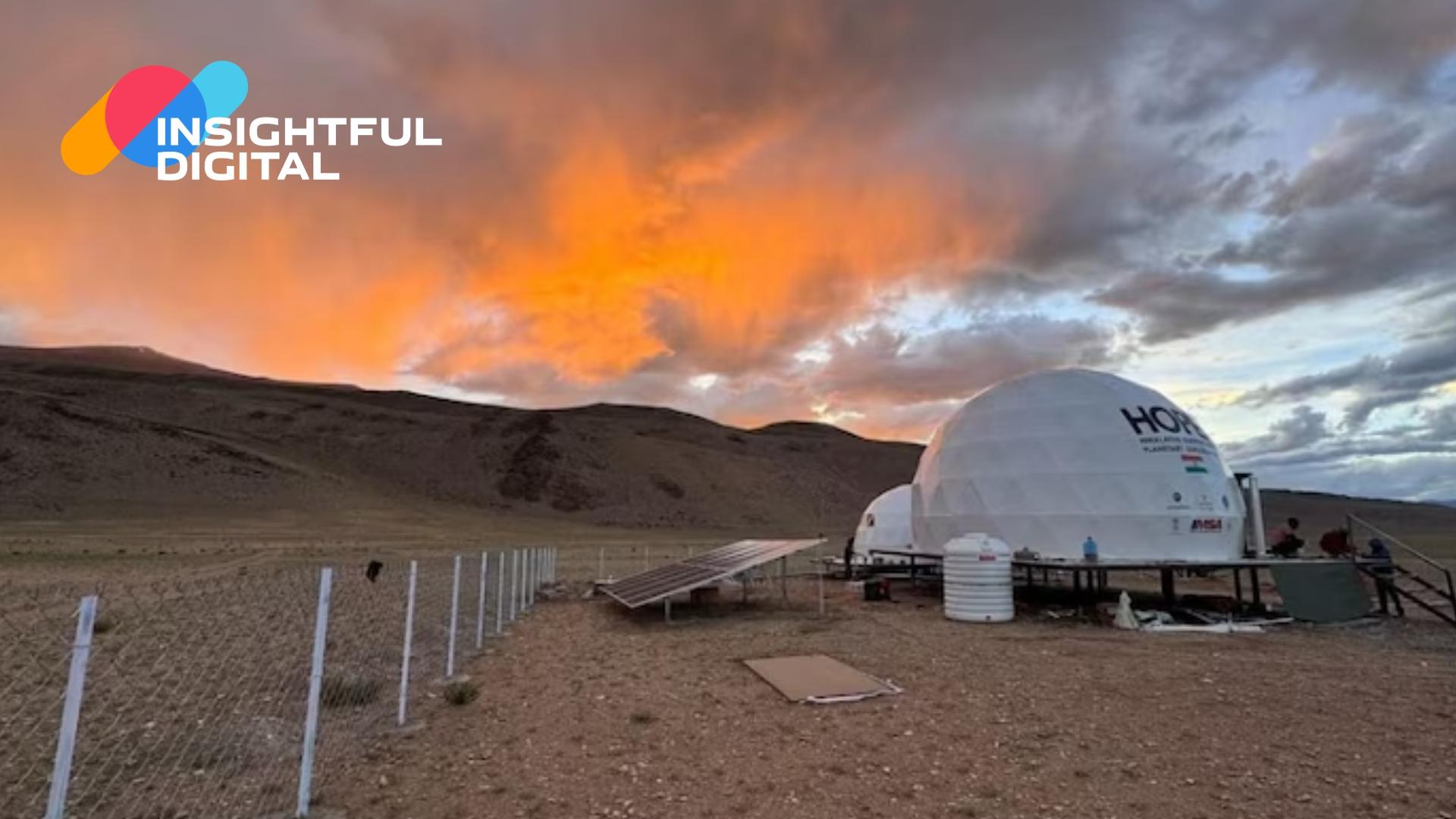
The Tso Kar basin in Ladakh serves as a near-perfect Earth analogue to Mars. The region's high elevation, extreme cold, and sparse vegetation mirror the Martian surface, making it ideal for simulating extraterrestrial life-support and survival conditions. ISRO has set up the HOPE experiment here to study how humans can adapt in such isolated and hostile environments.
Inside the HOPE Mission Simulation
Running from August 1 for a duration of 10 days, the HOPE mission features a team of researchers and test subjects confined to a controlled habitat. This structure mimics a Martian outpost, with pressurized living modules and essential life-support mechanisms.
Key areas under study include:
- Recycling and managing limited resources such as air, water, and food
- Psychological effects of isolation and team behavior under stress
- Response to extreme cold and reduced oxygen levels
Exploring the Martian Surface – On Earth
The mission also includes tests on rover mobility across Ladakh’s rocky terrain, which closely resembles the uneven surface of Mars. Astronauts-in-training will also participate in simulated "Mars walks" using advanced spacesuit prototypes. These trials are crucial for preparing for future extravehicular activities (EVAs) on Mars.
How HOPE Contributes to India's Space Goals
Data from the mission will directly impact ISRO’s future plans:
- Improving the design of space habitats for long-duration missions
- Providing hands-on analogue training for astronauts in preparation for interplanetary travel
- Supporting the Gaganyaan mission and future Mars-bound crewed projects
Global Analogue Missions: Where India Stands
While other countries like the USA and China have run similar simulations—such as NASA’s HI-SEAS in Hawaii and China’s Lunar Palace—India’s high-altitude, low-oxygen Ladakh landscape gives its mission a unique advantage. HOPE puts ISRO among the top contenders in preparing for human presence on Mars.
What’s Next for India’s Mars Ambitions?
Though no date is confirmed for a crewed Indian Mars mission, initiatives like HOPE signal strong intent. If successful, this could lead to more advanced simulations, deeper international collaborations, and potentially an Indian presence on Mars by the 2040s.
Conclusion
ISRO’s HOPE mission is not just a scientific experiment—it’s a bold stride toward human expansion into the cosmos. Ladakh’s Mars-like terrain offers an invaluable testing ground as India continues to transform space dreams into reality, one simulation at a time.
Objective Questions for Competitive Exams
Q.1. What is the full form of ISRO’s HOPE mission?
a) Human Operational Planetary Exploration
b) Human Outer Planetary Exploration
c) High Orbit Planetary Experiment
Answer: b) Human Outer Planetary Exploration
Q.2. Which location is being used by ISRO to simulate Martian conditions?
a) Siachen Glacier
b) Rann of Kutch
c) Tso Kar Valley, Ladakh
Answer: c) Tso Kar Valley, Ladakh
Q.3. Which Indian mission is expected to benefit most from the HOPE simulation?
a) Gaganyaan
b) Aditya-L1
c) Chandrayaan-4
Answer: a) Gaganyaan
Q.4. What aspect of astronaut training is emphasized in the HOPE mission?
a) Rocket launch operations
b) Interstellar navigation
c) Psychological resilience and resource management
Answer: c) Psychological resilience and resource management
Q.5. Which international Mars simulation is based in Hawaii?
a) MDRS
b) HI-SEAS
c) Lunar Palace-1
Answer: b) HI-SEAS
Q.6. What is the long-term goal of ISRO's HOPE mission?
a) Satellite deployment
b) Martian soil mining
c) Prepare for crewed Mars exploration
Answer: c) Prepare for crewed Mars exploration