
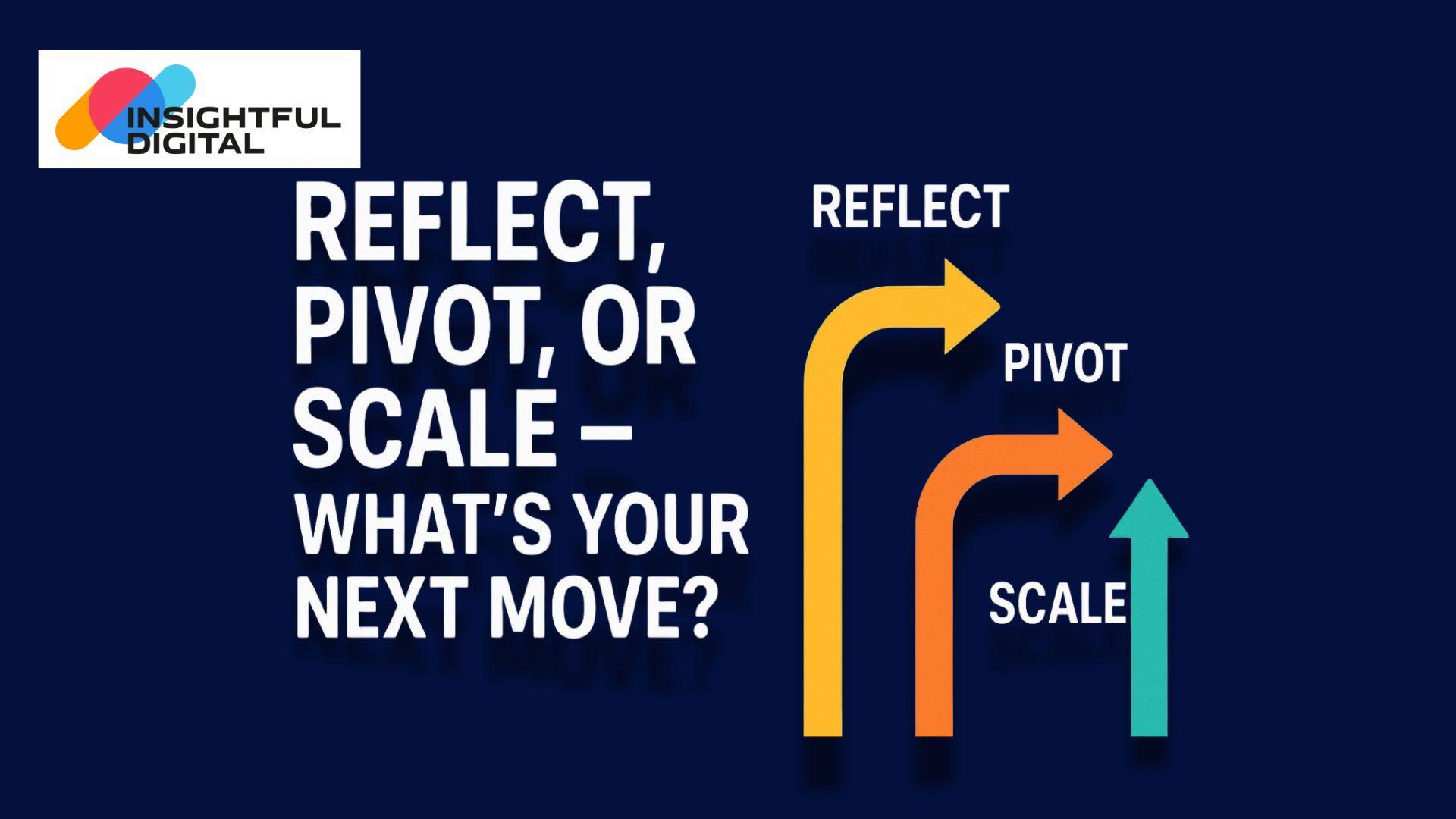
If you run a startup long enough, you hit this moment where you sit back and think: “Okay… now what?” Things aren’t as simple as they were on day one. You have some wins, some losses, and maybe even a team looking at you for the next big call. That’s usually when the real question pops up-should you reflect, pivot, or scale?
Reflect – Don’t Rush the Next Step
Most founders don’t like stopping. We were wired to keep moving. But sometimes slowing down is exactly what’s needed. Reflection isn’t about doing nothing-it’s about asking the questions we avoid when we are busy chasing growth.
Are customers actually happy, or just being polite?
Is the product solving the right problem, or are we forcing it?
Do we still believe in the mission we started with?
Reflection gives your perspective. Without it, you might end up sprinting in the wrong direction.
Pivot – Change Without Shame
If reflection shows you that things aren’t working, the next logical move is a pivot. And honestly, there’s no shame in it. The startup world celebrates pivots because they prove you were listening.
Think about it-Instagram wasn’t born as Instagram. Slack wasn’t built as Slack. These companies pivoted when the old road ended, and the new one looked clearer.
A pivot can be tiny, like adjusting your pricing, or massive, like switching industries altogether. Either way, it’s not failure-it’s survival with style.
Scale – Push the Accelerator
Then there’s scaling. This is the dream scenario-when customers love what you’re building, demand is growing, and you’re confident enough to think bigger. Scaling is fun but also risky.
Hiring too fast, spending too freely, or chasing every new opportunity can break a startup. The key is controlled growth-adding structure without killing the spark that got you here.
So, What’s Your Move?
There’s no universal answer. Some weeks you need reflection, other months demand a pivot, and occasionally the stars align for scale.
Here’s a rough test:
• If you’re unclear → Reflect.
• If you’re hitting walls → Pivot.
• If the market is pulling you forward → Scale.
At the end of the day, the smartest founders aren’t the ones who always scale. They’re the ones who know when to pause, when to shift, and when to push forward.
Final Note
Building a company is messy. It won’t follow the neat diagrams in pitch decks. But that’s the beauty of it-you are constantly learning, adjusting, and making calls that shape the future.
So maybe today’s not about scaling to the moon. Maybe it’s about sitting quietly, looking at the bigger picture, and asking yourself: what’s the real next move?
MCQs for Readers:
1. In the context of startups, what does “Reflect” primarily mean?
a) Stopping all operations
b) Evaluating progress and asking critical questions
c) Launching a new product immediately
d) Scaling the business quickly
👉 Answer: b) Evaluating progress and asking critical questions
2. Which of the following is a key benefit of reflection in entrepreneurship?
a) It avoids customer feedback
b) It helps in checking alignment with goals and vision
c) It guarantees instant growth
d) It reduces competition
👉 Answer: b) It helps in checking alignment with goals and vision
3. What does “Pivot” mean in a startup journey?
a) Shutting down the business completely
b) Rebranding without changing the model
c) Making a strategic shift in direction based on insights
d) Hiring more employees for expansion
👉 Answer: c) Making a strategic shift in direction based on insights
4. Which company is a famous example of a successful pivot?
a) Coca-Cola
b) Instagram
c) Toyota
d) Microsoft Excel
👉 Answer: b) Instagram
5. A pivot is most likely needed when a startup is:
a) Experiencing rapid customer growth
b) Stuck or misaligned with customer needs
c) Generating high profits
d) Already scaling smoothly
👉 Answer: b) Stuck or misaligned with customer needs
6. What does “Scaling” primarily involve?
a) Slowing down business operations
b) Expanding sustainably with stronger systems and processes
c) Shifting to an entirely new industry
d) Reflecting on past decisions
👉 Answer: b) Expanding sustainably with stronger systems and processes
7. What is the biggest risk of scaling too early?
a) Stronger brand identity
b) Overextending and collapsing due to weak foundations
c) Faster customer acquisition
d) Easier fundraising opportunities
👉 Answer: b) Overextending and collapsing due to weak foundations
8. Which of the following best summarizes the “Reflect, Pivot, Scale” approach?
a) A fixed formula every startup must follow
b) A flexible framework to decide the next business move
c) A government-approved startup program
d) A way to reduce team size
👉 Answer: b) A flexible framework to decide the next business move
9. Which signal usually indicates the right time to scale?
a) Falling customer engagement
b) High demand and solid traction
c) Frequent changes in product strategy
d) Lack of clarity in goals
👉 Answer: b) High demand and solid traction
10. What is the correct sequence of actions when a founder feels unclear, stuck, and then ready?
a) Scale → Pivot → Reflect
b) Pivot → Reflect → Scale
c) Reflect → Pivot → Scale
d) Reflect → Scale → Pivot
👉 Answer: c) Reflect → Pivot → Scale
11. What quality differentiates smart founders according to the article?
a) Always scaling faster than others
b) Knowing when to pause, shift, or push forward
c) Avoiding customer feedback
d) Copying competitor strategies
👉 Answer: b) Knowing when to pause, shift, or push forward
12. Which of the following statements is TRUE?
a) Pivot means giving up on the business entirely
b) Reflection ensures wasted effort in decision-making
c) Scaling is about growing sustainably, not just faster
d) Reflection is only needed at the launch stage
👉 Answer: c) Scaling is about growing sustainably, not just faster