
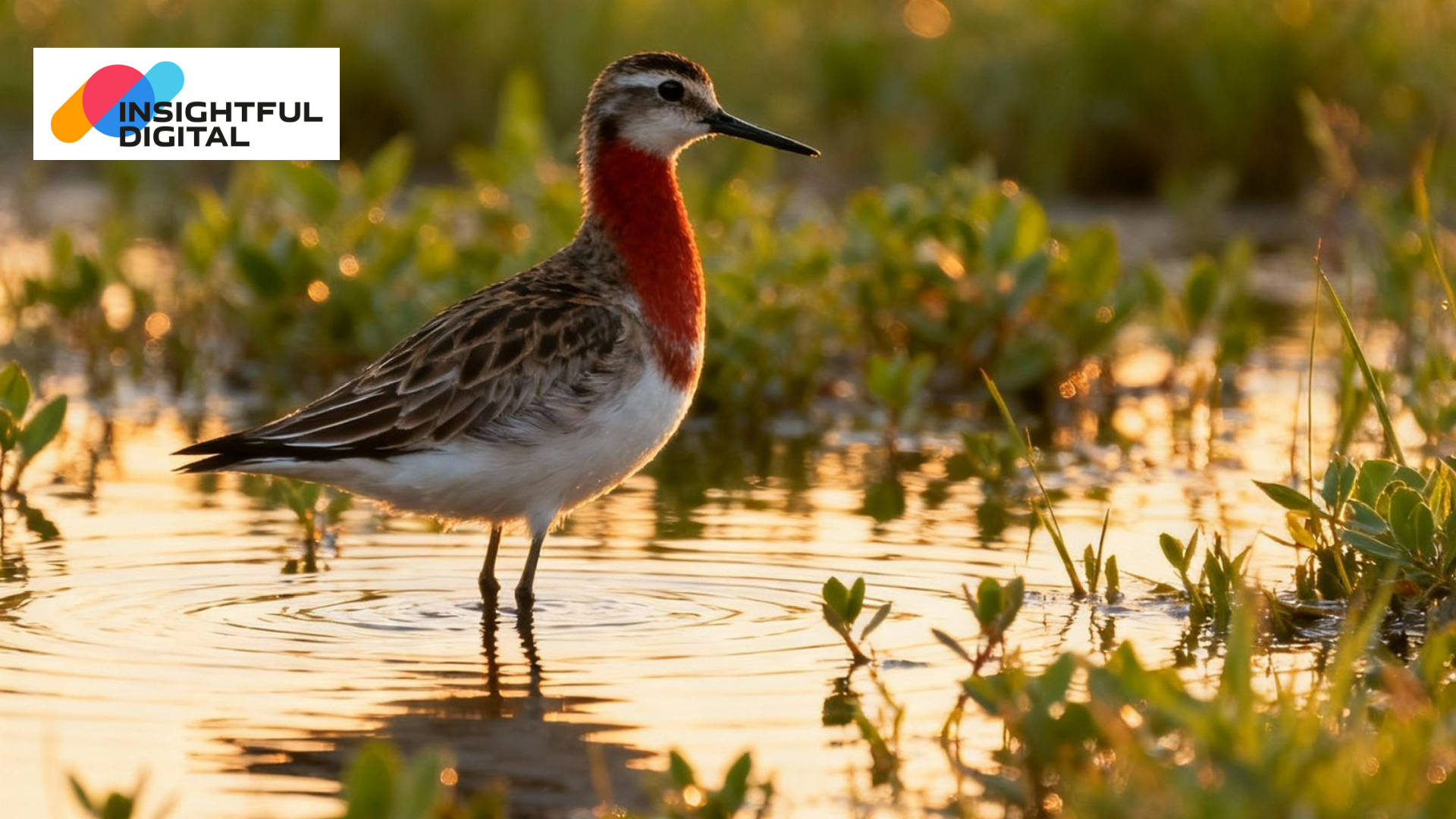
It was just another day for birdwatchers at a Tamil Nadu wetland, until someone noticed a small bird spinning circles on the water. At first glance, it looked like any other wader. But on closer look, binoculars confirmed the surprise - it was a Red-Necked Phalarope, a species rarely seen in India.
Not a Usual Guest
This bird breeds in the Arctic and normally spends winters far out at sea. India isn’t really on its map. So its stop in Tamil Nadu feels unusual, almost like a detour. Birders who spotted it couldn’t hide their excitement. One of them said, “You don’t come here expecting to see this. It’s like running into a traveler who took the wrong train and ended up at your station.”
Small Bird, Big Story
The Red-Necked Phalarope is tiny - just about 18 to 20 cm long. In breeding season, it shows a reddish neck, giving the species its name. Off season, the bird looks plainer, in soft gray and white, which is why casual observers might miss it.
Its behavior is what really grabs attention. Phalaropes feed by whirling in circles on water. Those little spins create mini whirlpools that pull up insects and tiny crustaceans. It’s a feeding trick you won’t forget once you’ve seen it.
And here’s a twist. In this species, the female takes the lead. She’s more colorful, courts the male, lays eggs, and then leaves. The male is left behind to incubate and raise the young. A rare role reversal in the bird world.
Tamil Nadu’s Place in Migration
India sits on the Central Asian Flyway - a route used by millions of migratory birds every year. Tamil Nadu’s coastal areas, lagoons and saltpans are regular halts for flamingos, pelicans, and shorebirds. The sudden visit of a phalarope reminds us that these wetlands matter far beyond local birdlife.
Some experts believe climate change and shifting winds may push certain species off their usual course. That could explain why a bird that spends winters on the open ocean turned up inland here.
Wetlands Under Pressure
While the sighting is a delight for birders, it’s also a reminder of the fragile state of Tamil Nadu’s wetlands. Many are shrinking due to urban growth, pollution, and industrial projects. Yet they remain vital - not just for birds, but also for fishing communities and farmers.
A single sighting won’t save these places, but it does put them back in conversation. Photos of the phalarope quickly spread on social media, adding weight to calls for conservation.
A Rare Memory
For the birding community, this is one of those moments they’ll talk about for years. Some rushed to the site just for a glimpse. Others logged it in their notebooks with a sense of disbelief. For scientists, it’s another data point on how migratory patterns may be shifting.
Closing Note
The Red-Necked Phalarope’s brief visit to Tamil Nadu is not just a rare tick on a checklist. It’s proof of how deeply connected our world is - from the Arctic tundra to Indian wetlands. Protect these spaces, and every now and then, we’ll be rewarded with a traveler from faraway seas.
MCQs for Readers:
1. Where was the Red-Necked Phalarope recently spotted in India?
a) Kerala
b) Tamil Nadu
c) Gujarat
d) Rajasthan
Answer: b) Tamil Nadu
2. The Red-Necked Phalarope usually breeds in which region?
a) South Asia
b) Arctic regions
c) African wetlands
d) Middle East
Answer: b) Arctic regions
3. What unique feeding behavior is the Red-Necked Phalarope known for?
a) Pecking at tree bark
b) Diving deep underwater
c) Spinning in circles on water
d) Hunting in flocks
Answer: c) Spinning in circles on water
4. In the Red-Necked Phalarope species, which gender incubates the eggs?
a) Female
b) Male
c) Both
d) Neither
Answer: b) Male
5. What is the size of the Red-Necked Phalarope?
a) 30–35 cm
b) 18–20 cm
c) 50–55 cm
d) 10–12 cm
Answer: b) 18–20 cm
6. Which migratory route passes through India?
a) East Atlantic Flyway
b) Central Asian Flyway
c) Pacific Flyway
d) Mediterranean Flyway
Answer: b) Central Asian Flyway
7. What is the main threat to Tamil Nadu’s wetlands?
a) Urbanization and pollution
b) Snowfall
c) Earthquakes
d) High altitude
Answer: a) Urbanization and pollution
8. What color patch gives the Red-Necked Phalarope its name?
a) Blue head
b) Red neck
c) Green tail
d) Yellow chest
Answer: b) Red neck
9. During non-breeding season, the bird’s plumage is mostly:
a) Bright red and green
b) Black and yellow
c) Gray and white
d) Blue and brown
Answer: c) Gray and white
10. Why is the Red-Necked Phalarope sighting in Tamil Nadu significant?
a) It is commonly seen in India
b) It indicates shifting migratory routes
c) It breeds in Tamil Nadu
d) It is a resident bird of the state
Answer: b) It indicates shifting migratory routes