
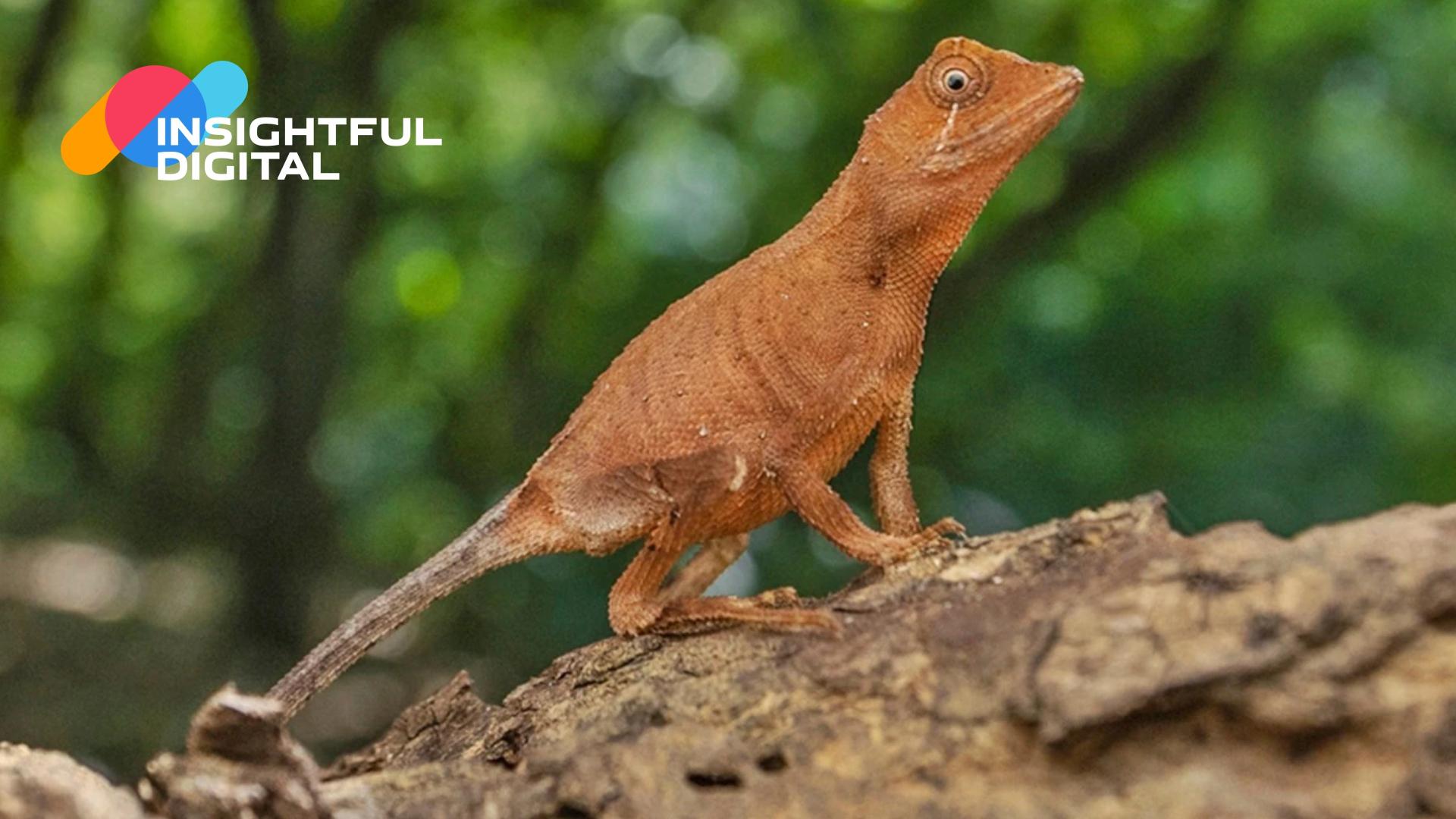
Researchers have identified a new species of lizard, Agastyagama edge, in the Western Ghats. Due to the reduction of the fifth toe, these poor climbers prefer terrestrial habitats.
In a remarkable discovery, scientists have identified a new species of small lizards in the biodiversity-rich forests of the Western Ghats, describing them as "little dragons." The newly found species, named Agastyagama edge or Northern Kangaroo Lizard, belongs to the Agamidae family, characterized by its small size and a maximum snout-vent length of 4.3 cm.
Key Information
This species is the second in the Agastyagama genus, following A. beddomei, which was first described in the Shervarayan hills of Tamil Nadu. The recent discovery was made by a collaborative team of scientists from various institutions in India and abroad, conducting research in the southern Western Ghats at Kulamavu in Idukki.
Distinctive Traits
Reduced Toes: The Kangaroo Lizard has a reduced fifth toe, making them poor climbers. Unlike other lizards, they prefer terrestrial habitats with dense leaf litter cover, where they run quickly and take refuge in dry leaves to escape predators.
Discovery and Confirmation
Lead author Sandeep Das, a National Postdoctoral Fellow of the Science and Engineering Research Board (SERB) at the University of Calicut, recalls the initial sighting during an expedition around 2015 in search of the elusive Mahabali frog. Initially thought to be A. beddomei, further evidence led researchers to suspect the existence of a new species. Subsequent sightings in the same location confirmed their hypothesis.
Analysis and Differentiation
Morphological and genetic analyses confirmed the distinctiveness of the new species, with a geographical separation of approximately 80 km from the nearest distribution record.
Physical Characteristics
The newly discovered lizard has a uniformly light olive-brown body with a slightly darker head. Notably, its throat is white, and it has a broad dark brown stripe on its dewlap, adorned with brick-yellow scales on the outer edge.
Acknowledgment
The species named Agastyagama edge pays tribute to the Zoological Society of London's Evolutionarily Distinct and Globally Endangered (EDGE) program. This program supports various researchers, including lead author Dr. Das and co-author K.P. Rajkumar from the Aranyakam Nature Foundation, focusing on conservation efforts for unique and endangered species.
Discovery Team
The collaborative efforts included researchers from various institutions, including Saunak Pal from the Bombay Natural History Society, Surya Narayanan from the Ashoka Trust for Research in Ecology and the Environment, K. Subin from the Kerala Forest Research Institute, Muhammad Jafer Palot from the Zoological Survey of India, and V. Deepak from the University of Wolverhampton.
Publication
The findings of this discovery are reported in the scientific journal Vertebrate Zoology, published by the Senckenberg Museum in Germany.
Important Questions for Competitive Exams
Q.1. What is the name of the new lizard species discovered in the Western Ghats?
a) Agastyagama edge
b) Agamidae beddomei
c) Mahabali frog
Answer: a) Agastyagama edge
Q.2. Where was the new species of lizard discovered?
a) Western Himalayas
b) Eastern Ghats
c) Western Ghats
Answer: c) Western Ghats
Q.3. What is the maximum snout-vent length of the new lizard species?
a) 3.5 cm
b) 4.3 cm
c) 5.1 cm
Answer: b) 4.3 cm
Q.4. Which program does the name Agastyagama edge pay tribute to?
a) EDGE
b) WWF
c) UNEP
Answer: a) EDGE
Q.5. What makes the Kangaroo Lizard a poor climber?
a) Reduced fifth toe
b) Short legs
c) Heavy body
Answer: a) Reduced fifth toe
Q.6. Which scientific journal published the findings of this discovery?
a) Nature
b) Science
c) Vertebrate Zoology
Answer: c) Vertebrate Zoology