

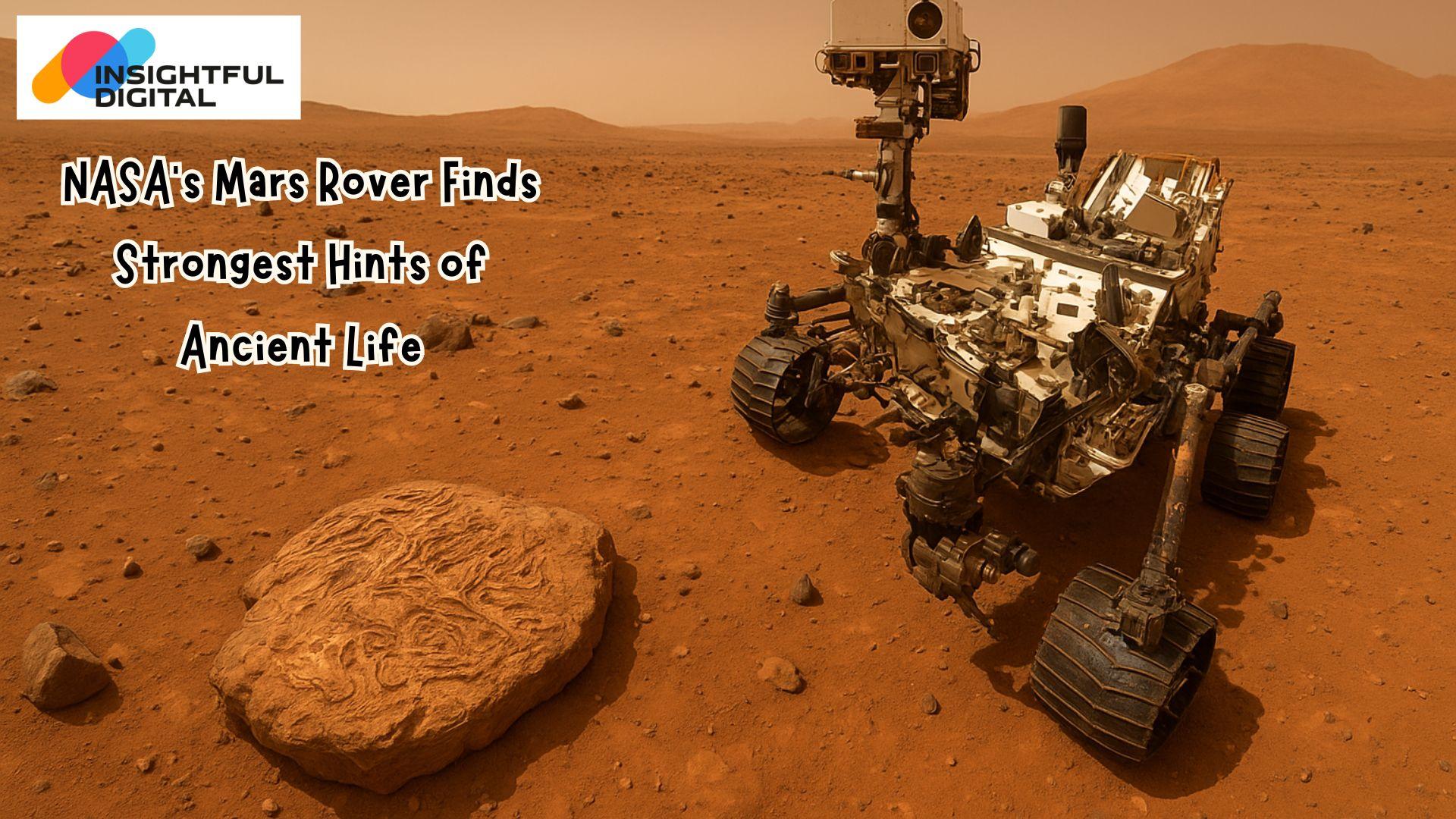
For as long as people have looked up at the night sky, Mars has held a special place in our imagination. It is close, it is mysterious, and it has always carried the question – could life have ever existed there? Now, NASA’s Perseverance rover has given scientists one of the clearest clues yet.
What the Rover Saw Beneath the Surface
Perseverance has been exploring Jezero Crater, an area believed to be an ancient lakebed. Think of it like Earth’s old river deltas, where water once flowed and left behind layers of mud and minerals. In those layers, the rover has picked up something remarkable – organic molecules and minerals that usually form in the presence of water.
Organic molecules are not proof of life by themselves, but they are life’s raw ingredients. Finding them in several layers of Martian rock makes scientists believe that Mars went through periods when it had all the right conditions to support tiny microbes.
Why Jezero Crater Was Chosen
Scientists didn’t pick Jezero Crater randomly. On Earth, river deltas act as natural “time capsules.” They trap sediments, preserve fossils, and often hide signs of past ecosystems. If Mars had anything similar, Jezero would be the place to look.
And now, evidence from the rover suggests this was once a watery environment. Imagine a shallow lake billions of years ago, slowly drying up but leaving behind chemical fingerprints that Perseverance is now reading.
How Perseverance Collects Clues
The rover isn’t just snapping photos. It is equipped with tools that can scan rock surfaces, identify chemicals, and even store rock samples in sealed tubes. These tubes will eventually be brought back to Earth, where powerful lab machines can do what no rover can – search for microscopic fossils or detailed chemical patterns linked to biology.
This upcoming Mars Sample Return mission could completely change how we see our place in the universe.
What It Means for Us
So why does this matter? If life managed to begin on Mars, even at the microbial level, it suggests life is not unique to Earth. It could mean the universe is full of life – waiting on other planets, moons, or even floating in interstellar space.
For future astronauts heading to Mars, these discoveries will also guide where to land, what to study, and how to protect both Earth and Mars from contamination.
Still a Mystery, but Closer Than Ever
NASA has not yet confirmed life on Mars. But with each rock drilled, Perseverance is piecing together a story that feels more and more possible. Maybe one day soon, when those samples come back to Earth, we will finally have the answer to a question humans have asked for centuries: Are we truly alone?
MCQs for Readers:
1. Which NASA rover recently detected strong hints of ancient life on Mars?
a) Curiosity
b) Perseverance ✅
c) Opportunity
d) Spirit
2. What type of evidence suggests ancient life on Mars?
a) Fossilized plants
b) Microbial biosignatures ✅
c) Water samples
d) Human artifacts
3. The discovery was made in which region of Mars?
a) Gale Crater
b) Jezero Crater ✅
c) Valles Marineris
d) Olympus Mons
4. What is NASA’s long-term goal with Mars exploration?
a) Build colonies
b) Search for life ✅
c) Mine resources
d) Test spacecraft
5. Which instrument on Perseverance helped detect signs of life?
a) MOXIE
b) SHERLOC ✅
c) Curiosity Cam
d) RoverCam
6. What makes Jezero Crater significant for astrobiology?
a) It contains lava flows
b) It is a former river delta ✅
c) It has the tallest mountain
d) It has ice deposits only
7. When did the Perseverance rover land on Mars?
a) 2018
b) 2020
c) 2021 ✅
d) 2023
8. Which upcoming mission aims to bring Mars samples back to Earth?
a) Artemis
b) Mars Sample Return ✅
c) Dragonfly
d) Starship
9. Evidence of ancient life on Mars primarily points to?
a) Multicellular organisms
b) Microbial life ✅
c) Human-like structures
d) Alien technology
10. Which space agency operates the Perseverance rover?
a) ESA
b) NASA ✅
c) ISRO
d) Roscosmos