

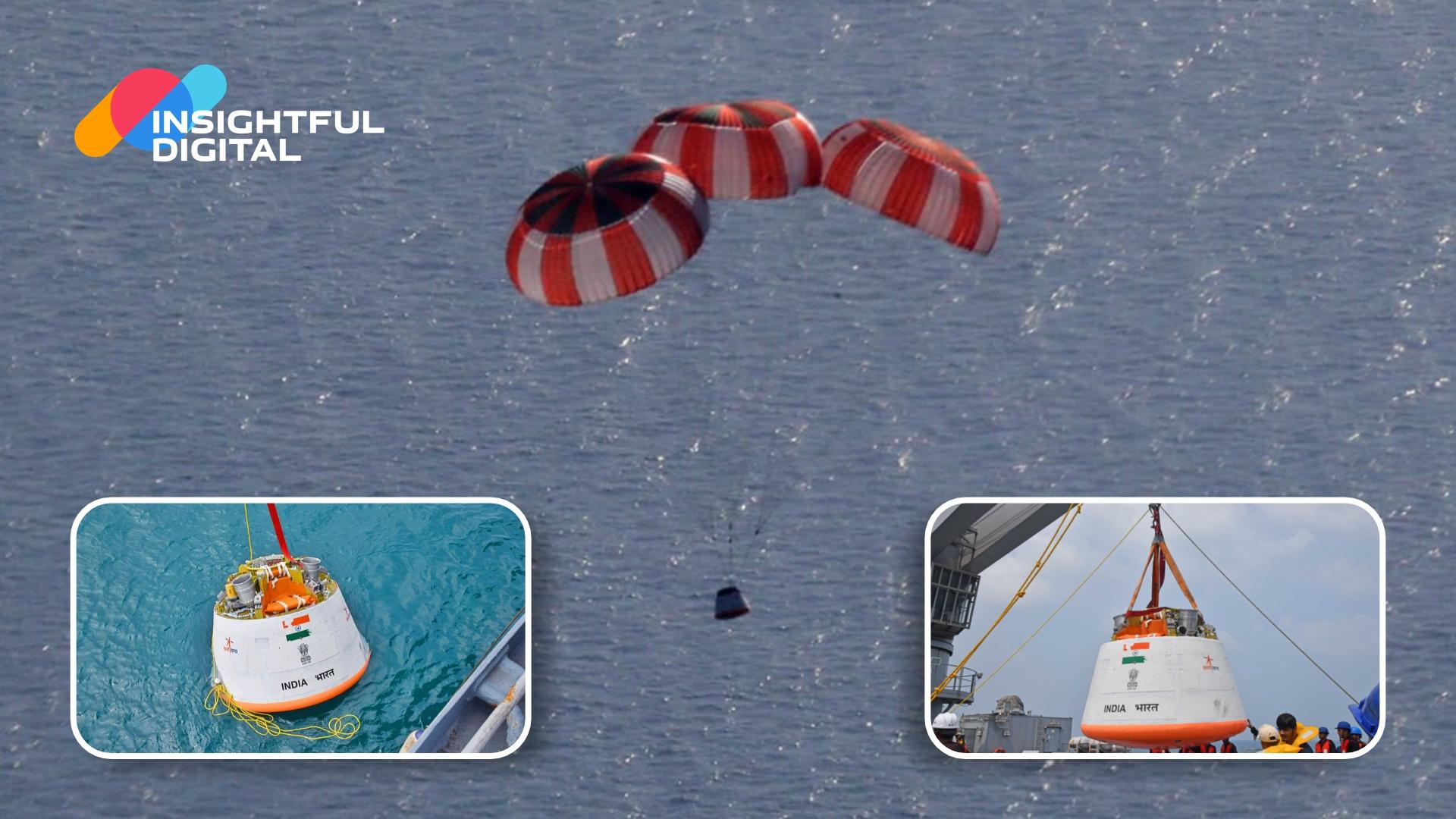
The Indian Space Research Organisation (ISRO) has achieved a major milestone in its ambitious Gaganyaan Mission by successfully conducting the first Integrated Air Drop Test (IADT-01). This test, executed on August 24, 2025, marks a significant step in validating the parachute-based deceleration system essential for ensuring crew safety during re-entry and landing of the crew module.
The trial was a joint effort involving the Indian Air Force, Defence Research and Development Organisation (DRDO), Indian Navy, and Indian Coast Guard, showcasing India's whole-of-nation approach to human spaceflight capability.
Significance of the Integrated Air Drop Test
The IADT-01 demonstrated the ability of the parachute system to decelerate and safely land the crew module. This is critical for astronaut safety, as the crew module must withstand re-entry forces and ensure a secure splashdown or landing after orbital missions.
The test represents coordinated synergy between ISRO and India's defence and research agencies, underscoring the inter-agency collaboration required for complex human spaceflight missions.
Progress in Gaganyaan Programme
Union Minister Dr. Jitendra Singh recently confirmed that the development and ground testing of the HLVM3 (Human Rated Launch Vehicle Mark-3) has been completed, ensuring the rocket is prepared for crew missions.
Propulsion systems for both Crew Module and Service Module have been tested. The Environmental Control and Life Support System (ECLSS) engineering model has been realized. The Crew Escape System (CES)—vital for astronaut safety in emergencies—has been developed with five types of motors already static-tested.
Key facilities are ready, including Orbital Module Preparation Facility, Gaganyaan Control Centre, Crew Training Facility, and Second Launch Pad modifications.
Precursor Missions and Future Steps
The TV-D1 mission validated the Crew Escape System. Preparations for TV-D2 and subsequent tests are ongoing. Realization of C32-G stage, HS200 motors, and CES modules completed. Structural modules for Crew Module and Service Module have been realized, with Phase-1 checks underway. This uncrewed mission will precede India's first human spaceflight, ensuring all systems are validated.
The Gaganyaan Mission is not an end, but the foundation of India's long-term human space programme. Future goals include Bharatiya Antariksha Station (BAS): India's own space station with five modules by 2035, for long-duration human missions in Low Earth Orbit. Indian Moon Landing by 2040: As per the Government's vision, India aims to put an astronaut on the Moon within the next 15 years, integrating lessons from Gaganyaan training and missions.
Objective Questions for Competitive Exams
Q.1. On which date did ISRO conduct the first Integrated Air Drop Test (IADT-01)?
a) August 15, 2025
b) August 24, 2025
c) September 1, 2025
d) July 30, 2025
Answer: b) August 24, 2025
Q.2. Which system was primarily validated through the IADT-01 test?
a) Launch escape system
b) Parachute-based deceleration system
c) Life support system
d) Communication system
Answer: b) Parachute-based deceleration system
Q.3. Which of the following agencies was NOT involved in the IADT-01 test?
a) Indian Air Force
b) Defence Research and Development Organisation (DRDO)
c) Indian Space Research Organisation (ISRO)
d) Indian Meteorological Department
Answer: d) Indian Meteorological Department
Q.4. What does HLVM3 stand for in the context of Gaganyaan mission?
a) High Launch Vehicle Mission-3
b) Human Landing Vehicle Module-3
c) Human Rated Launch Vehicle Mark-3
d) Heavy Launch Vehicle Mission-3
Answer: c) Human Rated Launch Vehicle Mark-3
Q.5. By which year does India plan to establish the Bharatiya Antariksha Station (BAS)?
a) 2030
b) 2035
c) 2040
d) 2045
Answer: b) 2035
Q.6. What was the purpose of the TV-D1 mission in the Gaganyaan program?
a) Test the parachute system
b) Validate the Crew Escape System
c) Test the life support system
d) Validate the launch vehicle
Answer: b) Validate the Crew Escape System