

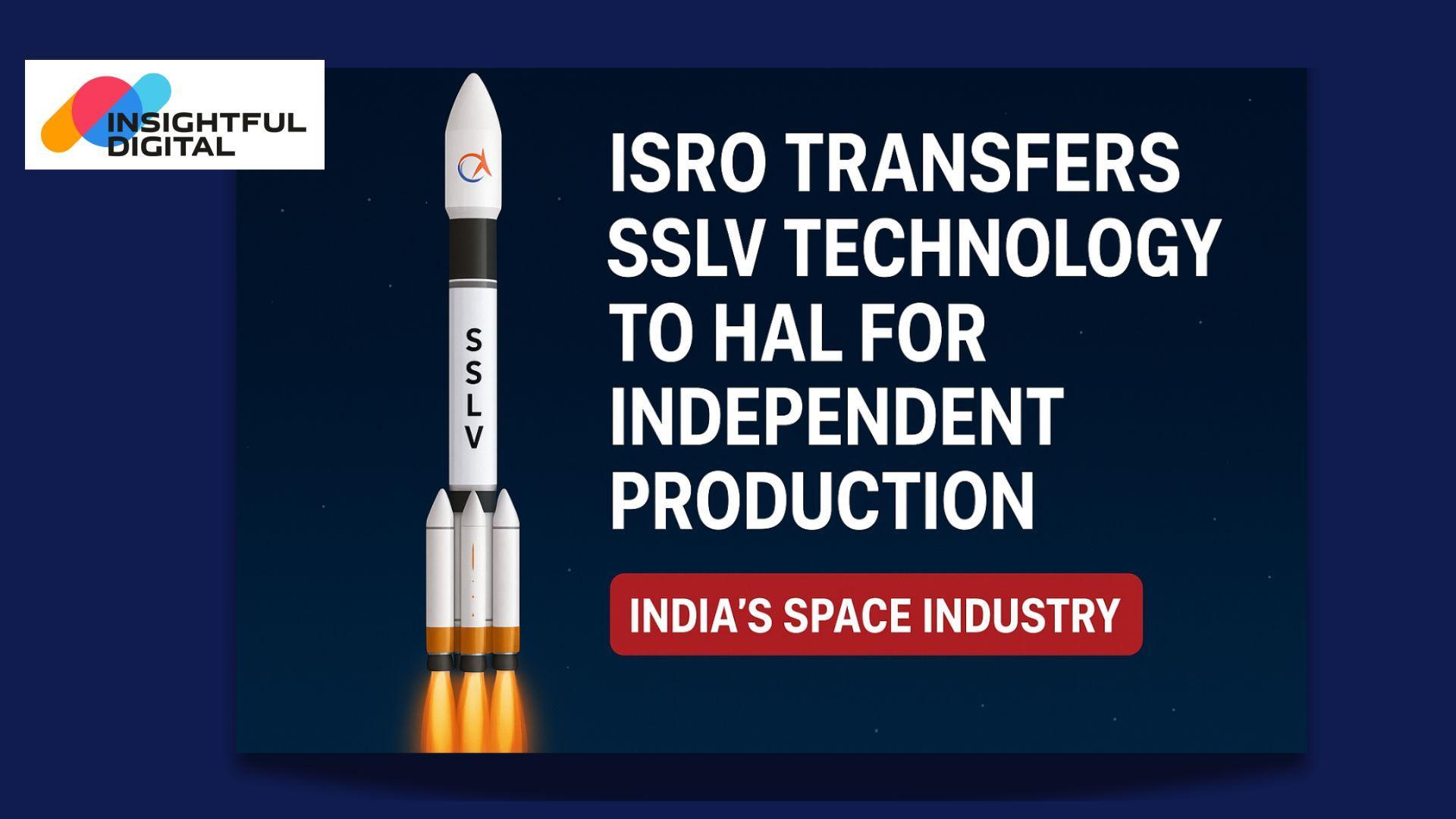
India’s space journey has always been about more than just rockets. It is about ambition, self-reliance, and a vision to be counted among the leading spacefaring nations. Recently, this journey took an interesting turn when ISRO officially transferred the technology for its Small Satellite Launch Vehicle (SSLV) to Hindustan Aeronautics Limited (HAL). On paper, it may look like another agreement between two government bodies. But in reality, it marks a shift in how India wants to build its space economy for the future.
The Promise of SSLV
For those who may not follow space news closely, the SSLV is one of ISRO’s most exciting projects. Unlike the heavy-lift rockets that grab headlines, this one is small, nimble, and designed to do a very specific job - launch small satellites quickly and at a lower cost.
Think of it as the budget airline of space launches. Instead of spending huge sums and waiting months for a slot on a big rocket, a research institute or even a start-up can use SSLV to get its satellite up in orbit with much less hassle. This is especially important at a time when small satellites are driving a lot of the growth in communication, navigation, and Earth observation.
Why HAL and Why Now?
Handing over the production rights to HAL is a smart move for more than one reason. ISRO, as brilliant as it is, cannot do everything on its own. Its scientists are already working on missions like Gaganyaan (India’s first human spaceflight), Chandrayaan’s follow-ups, and ambitious deep-space projects. That means routine satellite launch services need an industrial partner who can handle scale and efficiency.
HAL, with decades of experience in aerospace manufacturing, is well suited for this. It can take the SSLV from prototype to regular production, and eventually even offer it as a commercial product to global clients. By moving production out of ISRO’s labs and into HAL’s factories, India is showing that it wants its space program to be more industry-driven rather than limited to government facilities.
The Bigger Picture
This isn’t just about one rocket. It is part of a bigger strategy. The global small satellite launch market is booming, and countries are racing to provide reliable and affordable services. With SSLV in the hands of HAL, India can enter this race in a stronger way. The move also ties neatly into the government’s Atmanirbhar Bharat vision - encouraging local industries to handle advanced technologies and reduce reliance on foreign players.
Another angle is scale. ISRO’s launches are in high demand, but its capacity is limited. If HAL can manage SSLV production and operations, it means more satellites can go up, faster. This directly benefits universities, private companies, and international customers looking for cost-effective solutions.
What Lies Ahead
Of course, transferring technology is only the beginning. HAL will now have to prove that it can deliver SSLVs with the same reliability that ISRO has built its reputation on. The market will judge not just the cost, but also the consistency of launches. If done right, HAL could emerge as a new name in the global launch service business - something that would have been hard to imagine a decade ago.
For ISRO, this step means more freedom to focus on innovation and exploration. Instead of splitting attention between routine launches and cutting-edge missions, it can push the boundaries of science while HAL ensures satellites keep going up on schedule.
Closing Thoughts
The SSLV transfer may not make as many headlines as a moon landing or a human spaceflight, but it is no less important. It shows that India is building a more sustainable space ecosystem where industry and research work hand in hand. If ISRO is the brain, HAL is now becoming the muscle that will power India’s commercial ambitions in space. And together, they are setting the stage for a future where Indian rockets are not just carrying dreams to space - they are also shaping a global market.
MCQs for Readers:
1. What does SSLV stand for?
a) Standard Satellite Launch Vehicle
b) Small Satellite Launch Vehicle
c) Super Space Launch Vehicle
d) Satellite Service Launch Vehicle
✅ Answer: b) Small Satellite Launch Vehicle
2. Why is SSLV considered important for the space industry?
a) It can carry heavy satellites only
b) It reduces launch costs and time for small satellites
c) It is used only for military purposes
d) It replaces all existing rockets
✅ Answer: b) It reduces launch costs and time for small satellites
3. Which organization received the SSLV technology transfer from ISRO?
a) DRDO
b) HAL
c) BEL
d) NTPC
✅ Answer: b) HAL
4. How does HAL’s involvement benefit ISRO?
a) It eliminates ISRO’s research work
b) It allows ISRO to focus on advanced missions
c) It reduces India’s space ambitions
d) It shifts ISRO’s operations abroad
✅ Answer: b) It allows ISRO to focus on advanced missions
5. The SSLV technology transfer aligns with which national vision?
a) Digital India
b) Atmanirbhar Bharat
c) Make in Europe
d) One Earth One Future
✅ Answer: b) Atmanirbhar Bharat
6. What type of clients will benefit most from SSLV launches?
a) Large aerospace companies only
b) Start-ups, universities, and small satellite operators
c) Oil and gas industries
d) Agricultural cooperatives
✅ Answer: b) Start-ups, universities, and small satellite operators
7. What is the global trend driving the need for SSLVs?
a) Decreasing demand for communication satellites
b) Growing demand for small satellites
c) End of space exploration missions
d) Only military applications in space
✅ Answer: b) Growing demand for small satellites
8. What is a potential challenge for HAL in producing SSLVs?
a) Lack of international clients
b) Proving reliability and consistency in launches
c) Shortage of scientists at ISRO
d) Limited raw materials in India
✅ Answer: b) Proving reliability and consistency in launches