
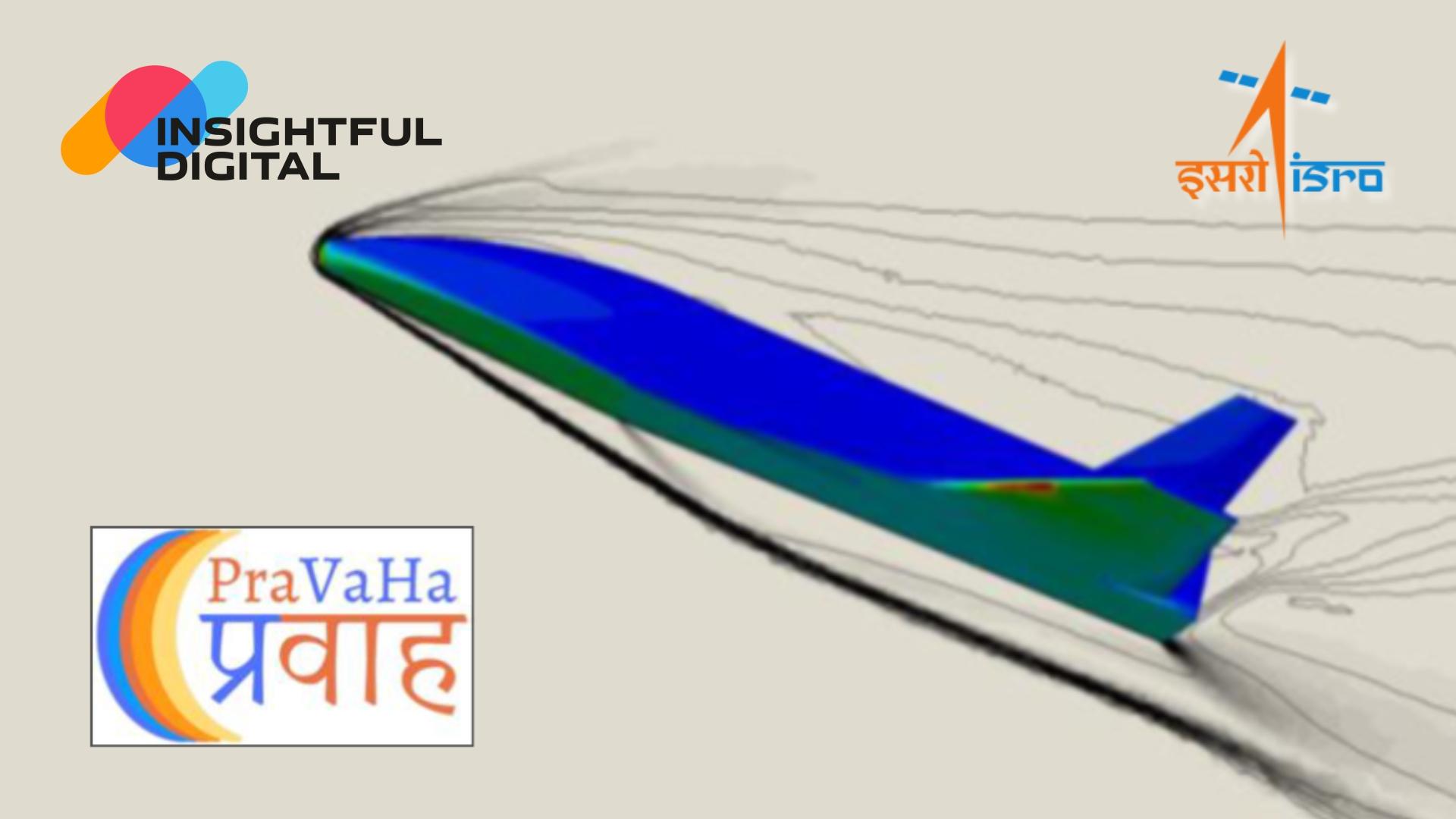
ISRO, through its Vikram Sarabhai Space Centre (VSSC), has introduced PraVaHa software, a Computational Fluid Dynamics (CFD) tool aimed at facilitating aerodynamic design and analysis for aerospace vehicles.
Aerodynamic Design and Analysis
PraVaHa, short for “Parallel RANS Solver for Aerospace Vehicle Aero-Thermodynamic Analysis,” is designed to simulate both external and internal flows over various types of vehicles, including launch vehicles, winged, and non-winged re-entry vehicles.
Functionality and Applications
This CFD software enables understanding of air flow around aircraft, rocket bodies, and crew modules, which is critical for shaping design elements such as structures and Thermal Protection Systems (TPS). It addresses challenges posed by unsteady aerodynamics, including flow disturbances and acoustic noise production during missions.
Capabilities and Scope
PraVaHa leverages advancements in CFD technology, providing accurate predictions for complex aerodynamic flows and fast simulation turnaround times, particularly on high-performance computing clusters. Its versatility extends to CPU and GPU architectures, making it suitable for current and upcoming supercomputing facilities.
Applications in the Gaganyaan Program
PraVaHa has played a crucial role in the Gaganyaan program, facilitating aerodynamic analysis for human-rated launch vehicles such as HLVM3, Crew Escape System (CES), and Crew Module (CM). Its collaborative framework allows partnerships with academic institutions and government laboratories.
Objective Questions for Competitive Exams
Q.1. What is the primary function of the PraVaHa software developed by ISRO?
a) To design spacecraft structures
b) To facilitate aerodynamic design and analysis for aerospace vehicles
c) To train astronauts
Answer: b) To facilitate aerodynamic design and analysis for aerospace vehicles
Q.2. What is the full form of PraVaHa?
a) Parallel RANS Solver for Aerospace Vehicles
b) Parallel RANS Solver for Aerospace Vehicle Aero-Thermodynamic Analysis
c) Parallel RANS Solver for Space Missions
Answer: b) Parallel RANS Solver for Aerospace Vehicle Aero-Thermodynamic Analysis
Q.3. Which program has PraVaHa played a significant role in?
a) Mars Mission
b) Gaganyaan Program
c) Chandrayaan Program
Answer: b) Gaganyaan Program
Q.4. What type of software is PraVaHa?
a) Image Processing Software
b) Computational Fluid Dynamics (CFD) Software
c) Data Analysis Software
Answer: b) Computational Fluid Dynamics (CFD) Software
Q.5. What challenges does PraVaHa address in aerospace vehicle design?
a) Fuel efficiency
b) Structural integrity
c) Unsteady aerodynamics and acoustic noise production
Answer: c) Unsteady aerodynamics and acoustic noise production
Q.6. On which architectures is PraVaHa software versatile?
a) CPU and GPU
b) FPGA and ASIC
c) Microcontroller and Microprocessor
Answer: a) CPU and GPU