
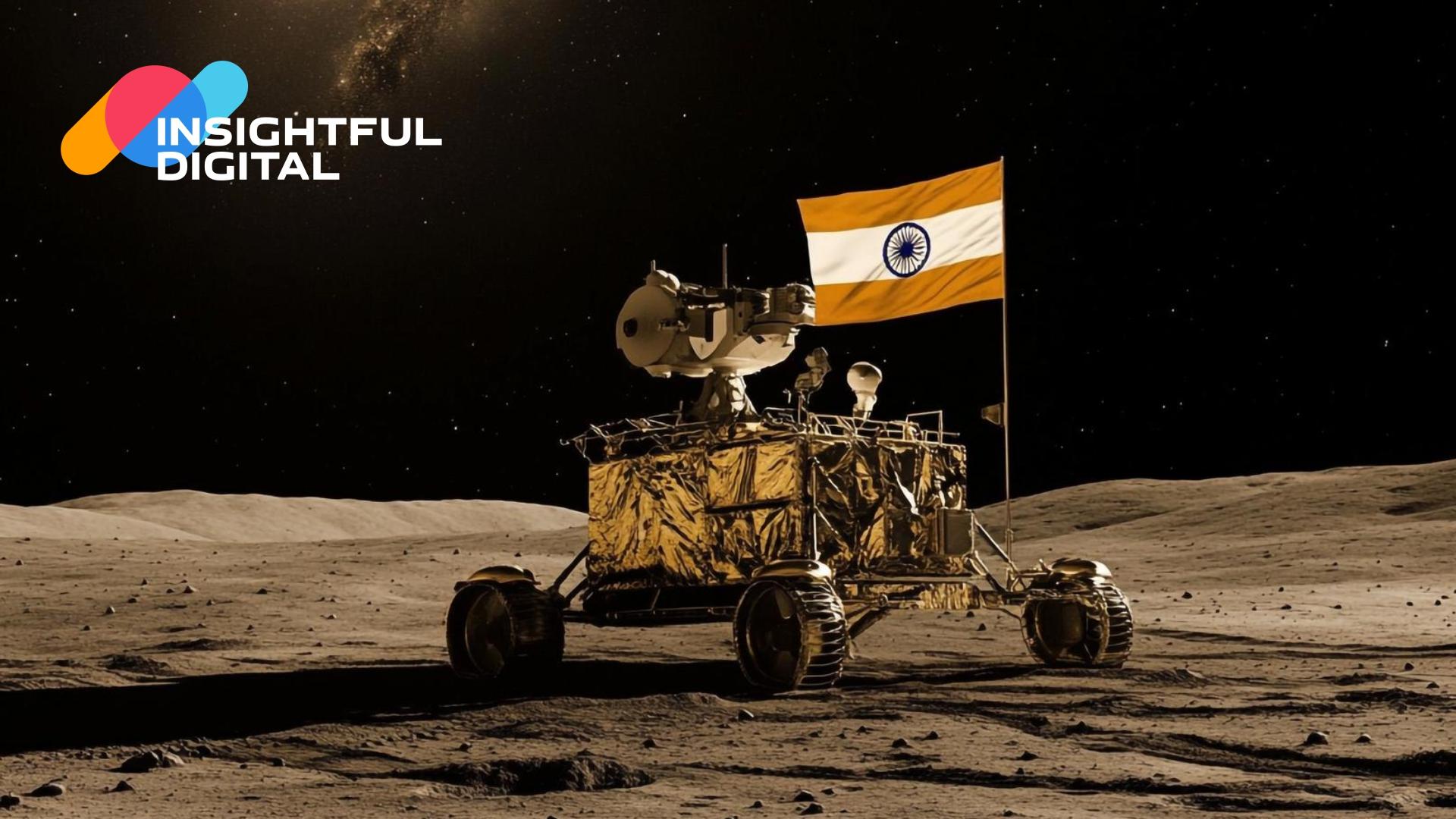
In a historic achievement, Indian scientists have developed the first comprehensive geological map of the Moon’s south pole. This groundbreaking map, created using high-resolution data from the Chandrayaan-3 mission, provides intricate insights into the topography, terrain features, crater distributions, and the geological evolution of the Moon’s least explored region.
Who Created the Map and How?
The research is the result of a scientific collaboration among three premier institutions: the Physical Research Laboratory (PRL), Ahmedabad; Panjab University, Chandigarh; and the Laboratory for Electro-Optics Systems (LEOS) of ISRO. By leveraging data from the Chandrayaan-3 lander and Pragyan rover, scientists have successfully charted the Moon’s south pole—a region of high interest due to its permanent shadow zones, cratered surface, and potential for water ice.
Key Geological Discoveries
The map reveals a mixture of highlands, lowlands, and secondary crater chains, indicating a dynamic and heavily impacted surface. One of the major discoveries includes crater alignments resulting from debris ejected during the formation of the Schomberger crater. This insight helps researchers decode the sequence of meteorite impacts and surface reshaping events over billions of years.
Estimated Age of the Region
The Moon’s south pole, as interpreted from geological layers and crater erosion patterns, is estimated to be around 3.7 billion years old. This period corresponds with a critical era in Earth’s history, during which early microbial life was beginning to form. The age correlation provides opportunities to compare planetary development in the early solar system.
Significance for Lunar Science and Exploration
The map serves as a critical tool for both scientific study and mission planning. Detailed terrain analysis can guide future landers and rovers, reducing landing risks and enhancing the efficiency of surface operations. Additionally, identifying areas with potential water ice can aid resource planning for long-term lunar habitation and future space colonization.
Discovery of Ancient Magma Confirms Lunar Hypothesis
One of the most crucial revelations from the Chandrayaan-3 mission is the confirmation of the "Lunar Magma Ocean Hypothesis". Using data from the Pragyan rover’s Alpha Particle X-ray Spectrometer (APXS), scientists detected remnants of ancient molten lava beneath the surface. This proves that the Moon once harbored a global magma ocean, which gradually solidified, forming the crust we observe today.
Global Relevance and India's Space Leadership
With this achievement, India strengthens its position in the international space research community. The mapping is timely, as global interest in lunar exploration rises with programs like NASA's Artemis missions, Russia’s Luna-25, and China’s Chang’e series. ISRO’s data will be invaluable in identifying strategic sites for exploration and even lunar resource mining.
Summary Table: Key Highlights of Moon’s South Pole Geological Map
🔹 What’s New: First high-resolution geological map of the Moon’s south pole
🔹 Conducted By: PRL, Panjab University, ISRO-LEOS
🔹 Geological Features: Highlands, lowlands, and crater chains
🔹 Surface Age: Approximately 3.7 billion years
🔹 Discovery: Confirmation of ancient subsurface magma
🔹 Strategic Importance: Supports future lunar missions and resource extraction
Objective Questions for Competitive Exams
Q.1. Which Indian lunar mission enabled the creation of the Moon’s south pole geological map?
a) Chandrayaan-1
b) Chandrayaan-2
c) Chandrayaan-3
Answer: c) Chandrayaan-3
Q.2. Which crater's debris shaped much of the Moon's south pole surface?
a) Tycho
b) Schomberger
c) Copernicus
Answer: b) Schomberger
Q.3. What is the estimated age of the Moon's south pole region as per the new map?
a) 2.1 billion years
b) 3.7 billion years
c) 4.5 billion years
Answer: b) 3.7 billion years
Q.4. Which instrument detected traces of ancient magma beneath the Moon’s surface?
a) Solar X-ray Monitor
b) Alpha Particle X-ray Spectrometer
c) Neutron Spectrometer
Answer: b) Alpha Particle X-ray Spectrometer
Q.5. What major lunar hypothesis was confirmed by Chandrayaan-3's findings?
a) Presence of lunar vegetation
b) Moon’s core is metallic
c) Existence of ancient global magma ocean
Answer: c) Existence of ancient global magma ocean
Q.6. Which of the following institutions was NOT part of the geological mapping project?
a) Physical Research Laboratory
b) Panjab University
c) Indian Institute of Science (IISc), Bangalore
Answer: c) Indian Institute of Science (IISc), Bangalore