
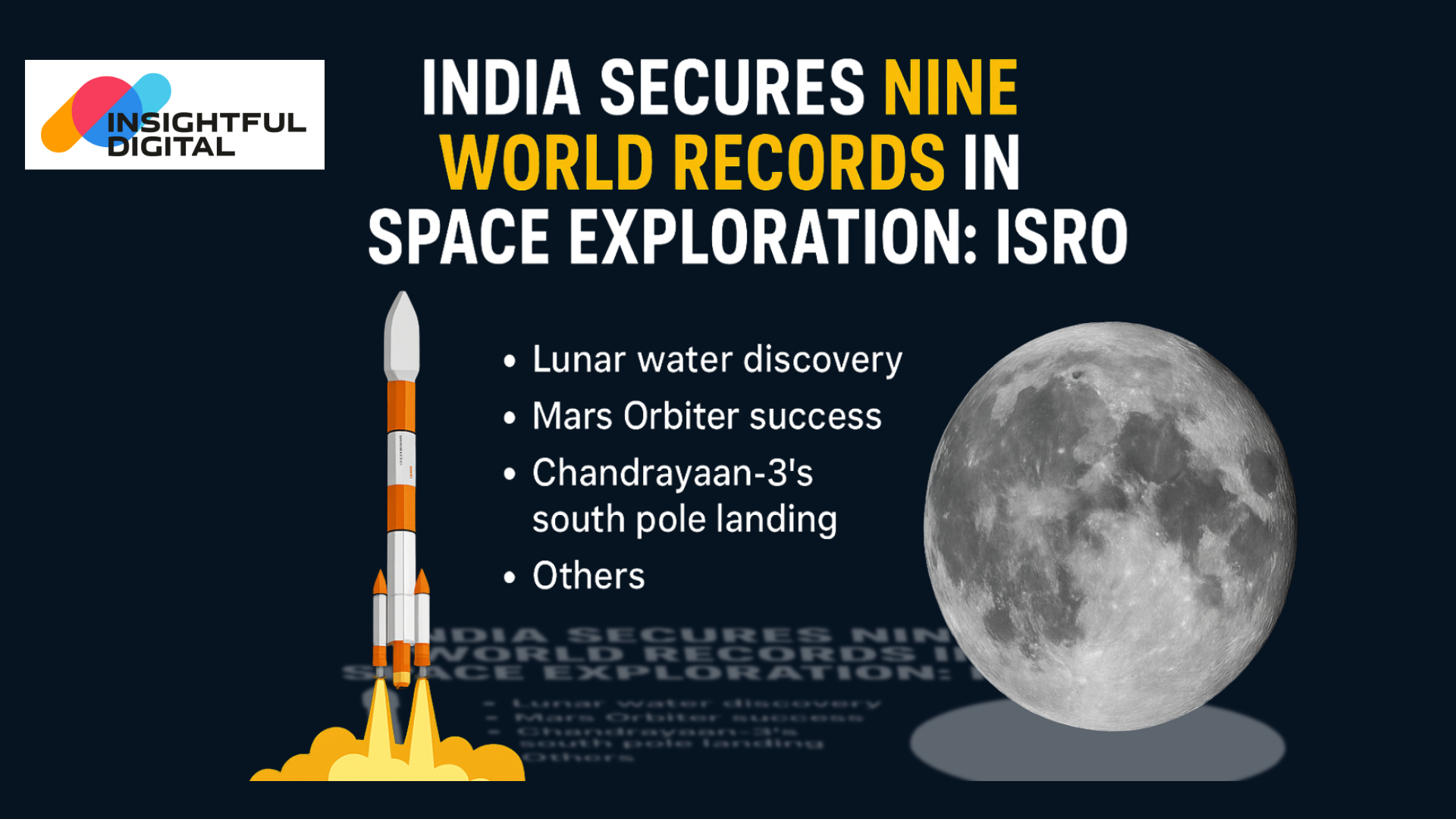
It’s been a landmark period for India’s space program. In recent remarks, ISRO’s chair confirmed that India has now earned nine significant world records in space exploration - with plans underway to add another eight to ten records in the near future.
What Were Those Nine Records?
These records span multiple missions and technologies. Some of the most notable achievements include:
Being the first to discover water molecules on the Moon’s surface, sub-surface, and exosphere during the Chandrayaan-1 mission.
Pulling off the Mars Orbiter Mission successfully in 2014 in its very first try - a feat unmatched by many.
Launching 104 satellites in a single mission in 2017 via a PSLV flight.
Equipping the Chandrayaan-2 orbiter with one of the best cameras operating in lunar orbit.
Successfully landing on the Moon’s south pole with Chandrayaan-3 in August 2023 and performing in-situ measurements of the lunar surface and near-surface environment for the first time.
Achieving multiple world records in cryogenic engine development - for example, launching with just three engines (while the world standard ranges between four and eleven), completing development in historically fast timelines, and operating hot-stage testing in record time.
These advances show that India isn’t just participating in space exploration - it’s pushing the boundaries.
How Did India Pull This Off?
According to ISRO leadership, two key things helped make this possible:
Frugal engineering - cutting cost without compromising on quality. ISRO’s testing and mission approval often undergo rigorous analysis, ensuring efficiency at every step.
Consistent momentum - from robotic arm innovations, docking experiments, and student tech launches, to globetrotting satellite missions, India’s expanding portfolio has helped build capability and confidence.
What’s Next on the Horizon?
The chairman also revealed that approximately 8–10 additional world records may be added soon. These likely tie into upcoming missions, cryogenic advancements, docking technologies, and new spacecraft design benchmarks. Some of the ongoing work includes developing India’s own space station modules and demonstrating capabilities like efficient in-orbit docking and power transfer experiments.
Why These Records Aren’t Just Numbers
These achievements matter deeply - not just for prestige, but for practical and economic impact:
They inspire young talent and keep science and tech fields exciting.
They improve India’s standing in global collaborations - more partnerships are possible when peer nations see your capability validated.
Cost-effective space missions open doors for domestic growth in satellite tech, navigation services, environmental monitoring, and disaster management.
A Word of Caution
Excitement notwithstanding, experts urge that records are stepping stones, not endpoints. Each new achievement calls for long-term validation - whether it’s sustaining equipment reliability, ensuring international regulatory compliance, or translating these milestones into lasting societal benefit. Only with time, repeated success, and transparent data can these records become legacy features of India’s space chapter.
Final Thought
India’s tally of nine major world records in space exploration is nothing short of extraordinary. From mapping lunar water to docking spacecraft, from cryogenic rockets to lunar landings at the moon’s south pole - each achievement tells a story of perseverance, innovation, and vision. As more records take shape, they won’t just sit in textbooks. They’ll translate into real technologies that power connectivity, clarity, and capability for millions.
Here’s to the next set of milestones - and to India pushing steadily onward, not just into space, but into the future.
MCQs for Readers:
Q1. How many world records has ISRO secured in space exploration so far?
a) 5
b) 7
c) 9
d) 11
Answer: c) 9
Q2. Which mission helped India discover water molecules on the Moon?
a) Chandrayaan-2
b) Chandrayaan-1
c) Chandrayaan-3
d) Mangalyaan
Answer: b) Chandrayaan-1
Q3. India’s Mars Orbiter Mission was successful on which attempt?
a) First
b) Second
c) Third
d) Fourth
Answer: a) First
Q4. How many satellites were launched by ISRO in a single mission in 2017?
a) 54
b) 82
c) 104
d) 120
Answer: c) 104
Q5. Chandrayaan-3 achieved a soft landing on which part of the Moon?
a) Equator
b) Near side
c) South Pole
d) Far side
Answer: c) South Pole
Q6. What is one of ISRO’s strengths that enabled record achievements?
a) Heavy international funding
b) Frugal engineering
c) Outsourced technology
d) Unlimited resources
Answer: b) Frugal engineering
Q7. ISRO is planning to add how many more world records soon?
a) 2–3
b) 4–5
c) 8–10
d) 12–15
Answer: c) 8–10